


Trump-Xi Pre-Meeting Analysis: Xi Jinping hands are tied – Trump lands in Beijing with the upperhand
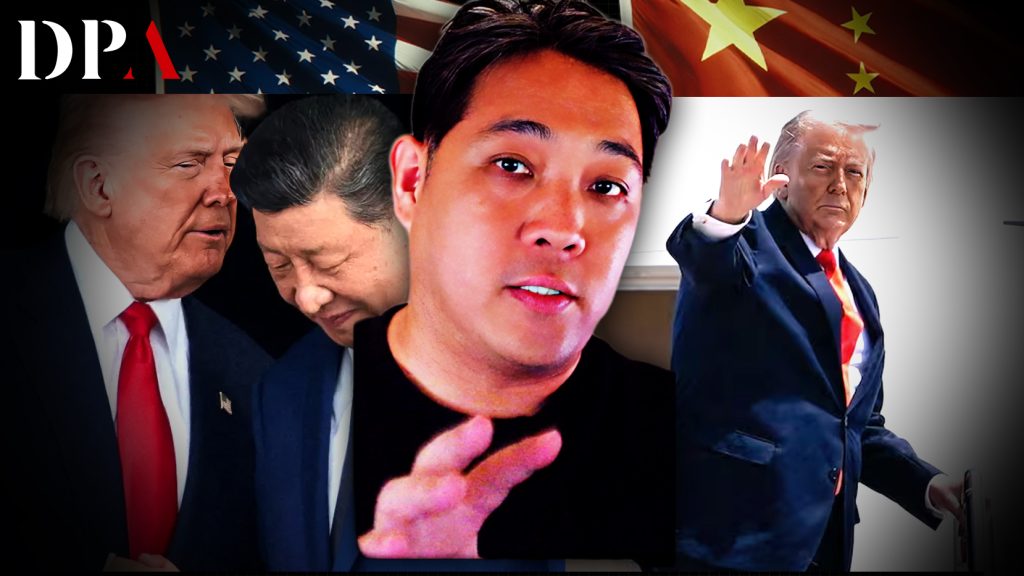
Trump is heading to Beijing—his first visit since the first term. This is not a meeting between equals. Xi Jinping is walking into a negotiation where the Americans already hold every card that matters. The board is set. China can only decide how gracefully to lose.
Japan Changed Everything
The biggest shift in East Asia isn’t the trade war. It’s Japan.
The new Japanese government has abandoned pacifism. They’ve declared outright: if China blockades Taiwan, Japan fights. And if Japan fights, the US follows.
People underestimate Japan’s military. It’s easily top-five in the world for high-tech capability. They don’t advertise it, but the hardware is there. And they’re not sitting still—they’re already exporting naval vessels to the Philippines and Indonesia, running joint exercises with American allies, and getting welcomed across Southeast Asia as the counterweight everyone was waiting for.
Balance of power keeps the peace. I’ve said this since 2022. When balance disappears, war becomes likely.
China’s Taiwan plans assumed weakness everywhere: a feeble America under Biden, a cowardly Japan, South Korea distracted by the North, Southeast Asia as a non-factor. Japan’s declaration blows that calculation apart.
Now if China moves on Taiwan, it has to defeat Japan too. Japan stretches roughly from Shanghai to Hong Kong in coastline terms. That’s a lot of territory, a lot of people, and a war that never ends cleanly. Add the cross-strait amphibious nightmare—remember what D-Day took just to land on a beach—and the military math for a Taiwan invasion goes from difficult to nearly impossible.
China’s Global Pawns Are Gone
Look around the world. Every piece Beijing had on the board has been swept off.
Venezuela was supposed to be the forward base keeping America busy in a great-power war. Gone. Maduro got removed, the new government flipped to Washington overnight, and now people are seriously discussing whether Venezuela should become a US state. That’s how complete the reversal was.
Cuba is paralyzed. No money, no oil, can’t keep the lights on. I give it six months before they kneel.
Iran was cheap oil, a Belt and Road node, and a thorn in America’s side. Now it’s a liability. The US blockade is airtight. Kharg Island has gone quiet—no tankers loading, a massive oil spill suggesting they’ve exceeded storage capacity and shut down. Iranian crude isn’t reaching China.
The UAE has fully pivoted to Washington and entered the war with airstrikes on Iranian oil facilities. Saudi Arabia may be launching covert attacks too. China’s Gulf investments are bleeding value. Even when oil moves, Hormuz is a chokepoint—though a handful of tankers passed through recently, which is the one small bright spot for Beijing.
Espionage networks inside the US are getting rolled up. Arrests at scale.
Canada faces an Alberta independence vote that could fracture the country permanently. Mexico is consumed by cartel warfare involving the US, the Mexican government, and the cartels in a three-way fight.
America has secured its backyard. China’s forward positions are gone.
The Trade War: China Stood Alone
Everyone else made a deal. The EU capitulated completely—total surrender to Trump’s demands. Xi toured Southeast Asia trying to rally Malaysia, Vietnam, Cambodia. It failed. Every country wanted the same thing: Chinese money, Chinese investment, Chinese purchases of their goods. China wasn’t offering any of that. The tour produced nothing.
China found itself completely isolated.
The Supreme Court struck down the legal mechanism Trump used to impose tariffs, forcing refunds to corporations. But the tariffs stay. Trump never cared whether other countries tariff American goods back. He cares about market access for US products and revenue that makes American manufacturing competitive again.
The tentative US-China deal? Strip away the theater and it’s just China accepting US tariffs while tariffing back. Trump got exactly what he wanted.
The Coupon Economy
Internally, China is struggling. Deflationary pressure. Youth unemployment. Real estate sector collapsed. Massive hidden debt at provincial and city levels that doesn’t show in national figures. Hundreds of banks closed. The financial system is stressed but not broken—China is still a state-capitalist system, not pure communist, so it won’t collapse the way Cuba might.
The bright spots are AI development and electric vehicles, though BYD’s global push has gone quieter this year compared to last year’s surge.
Here’s the structural problem Trump will push on, and Xi cannot give: financial opening.
The renminbi isn’t a real currency. It’s a coupon system. Think of it this way: workers get paid in factory coupons. The coupons work at the company canteen and company store. Outside the factory gates, they’re worthless. That’s the RMB internationally. Try exchanging it at a money changer overseas—they don’t want it unless it’s a government-to-government swap.
Why are Chinese goods so cheap? Because labor is paid in coupons. Real foreign currency from exports flows to the state, which uses it to buy resources, acquire foreign companies, and fund Belt and Road influence. It’s a valid strategy. It worked for decades.
But if China opens financially—if workers can exchange their coupons for real money and leave—the whole system reprices violently or collapses. Capital controls exist because free exchange would drain state reserves and strip the government of power.
Trump wants that opening. China cannot survive it.
COVID accelerated the exit. When China blocked medical exports during the pandemic, it spooked every country on earth. Foreign direct investment into China has cratered to near zero. Meanwhile, the US is seeing historic highs. That’s the real game.
And the cost of all those cheap Chinese goods? The world has been spending the future wealth of Chinese generations. Below-cost production doesn’t come free. Someone pays—and it’s China’s young people, inheriting debt their government will eventually print into banana notes.
What Trump Brings to Beijing
Chris Roland analyzed Trump’s delegation:
- Nvidia, Qualcomm, Micron — chips
- Boeing — headline orders for the photo op
- Cargill — soybeans
- Goldman Sachs, BlackRock, Citi — financial access
No energy CEOs. No defense contractors.
Roland’s read: the carrots are flying to Beijing; the sticks are waiting in the Persian Gulf.
Trump wants China to buy American, open some markets, and produce surface deals that look like friendship. Xi cannot sign anything that looks like surrender—that would be instant political death inside the CCP. He’d be pulled down fast.
The purges of generals and officials? Normal CCP politics. Every authoritarian system culls rising threats. It’s background noise.
The One Serious Topic: AI
If anything substantive gets discussed, it’s AI.
Both countries are racing hard. The risk isn’t just economic—it’s existential. If AGI arrives without coordination, if systems get too powerful too fast, you’re looking at Terminator scenarios. A US-China consensus on AI safety and control might be the one agenda item that actually matters for humanity’s future.
The UFO disclosures, the rumors about alien briefings for religious leaders—that’s sci-fi territory. Unlikely to drive the meeting.
The Verdict
Trump has already won the economic war. By my count, he’s won the geopolitical war too.
China is stranded. Russia is grinding forward in Ukraine but not winning decisively. Iran is losing and dragging China down. Venezuela flipped. The Arab world lost trust in Beijing. Japan has become the military vanguard of American policy in Asia—arming the Philippines, arming Indonesia, doing the work America should be doing, but closer.
Even Singapore, after years of careful diplomacy and real money spent keeping China happy, publicly praised Japan’s new defense posture. That infuriated Beijing. When Singapore is willing to take that hit, you know which way the wind is blowing.
Xi enters this meeting with nothing. The best he can do is surface deals—Boeing orders, soybean commitments, both sides declaring friendship and no war. Trump takes his victory lap. No regime concessions. No financial opening. No meaningful surrender.
China cannot win this meeting. They can only decide how much they lose in public.
Full Video Report: