


Trade War
Trump's Reform of the US-Led International Trade/Economic System
REPORTS & ANALYSIS
AWESOME MEETING!!! Xi Jinping & Trump heralds NEW POSITIONING between USA & China
The meeting went better than anyone expected. Xi Jinping and... Read more →
Trump-Xi Pre-Meeting Analysis: Xi Jinping hands are tied – Trump lands in Beijing with the upperhand
Trump is heading to Beijing—his first visit since the first... Read more →
The AI Space Race: Why SpaceX is Bailing Out Anthropic
Absolutely insane news in the AI world today. xAI—or more... Read more →

China is in dire straits, mirroring Japan’s decline into stagnation; but so are all of us…
Paolo ask, in DPA Chat: “Hey Wyatt, Can we get... Read more →
🇨🇳🇵🇰🇮🇳 Recent Developments in China-Pakistan Relations and India-Bangladesh Trade Dynamics
In recent geopolitical developments, China has extended its satellite support... Read more →
VIDEO REPORTS
TRADE BALANCE (USD Billions) MAP (OF EACH RESPECTIVE COUNTRY)
The above is an estimation based on information we are collect from open source intelligence and news reporting. We are not responsible for any mishap, misjudgment or losses resulted in the usage of the information presented in this map.
US TRADE BALANCE (USD Billions)
The above is an estimation based on information we are collect from open source intelligence and news reporting. We are not responsible for any mishap, misjudgment or losses resulted in the usage of the information presented in this map.
CURRENT "TRADE WAR" TARIFFS
latest tariff by Usa
China 145% >>> 10% (12 May 2025)
Canada 25% for non-USMCA
Mexico 25% for non-USMCA
European Union 10% until 8 July 2025
Countries tariffed above 10% 10% until 8 July 2025
Other countries 10%
latest retaliatory tariff on Usa
China 125% >>> 10% (from 12 May 2025)
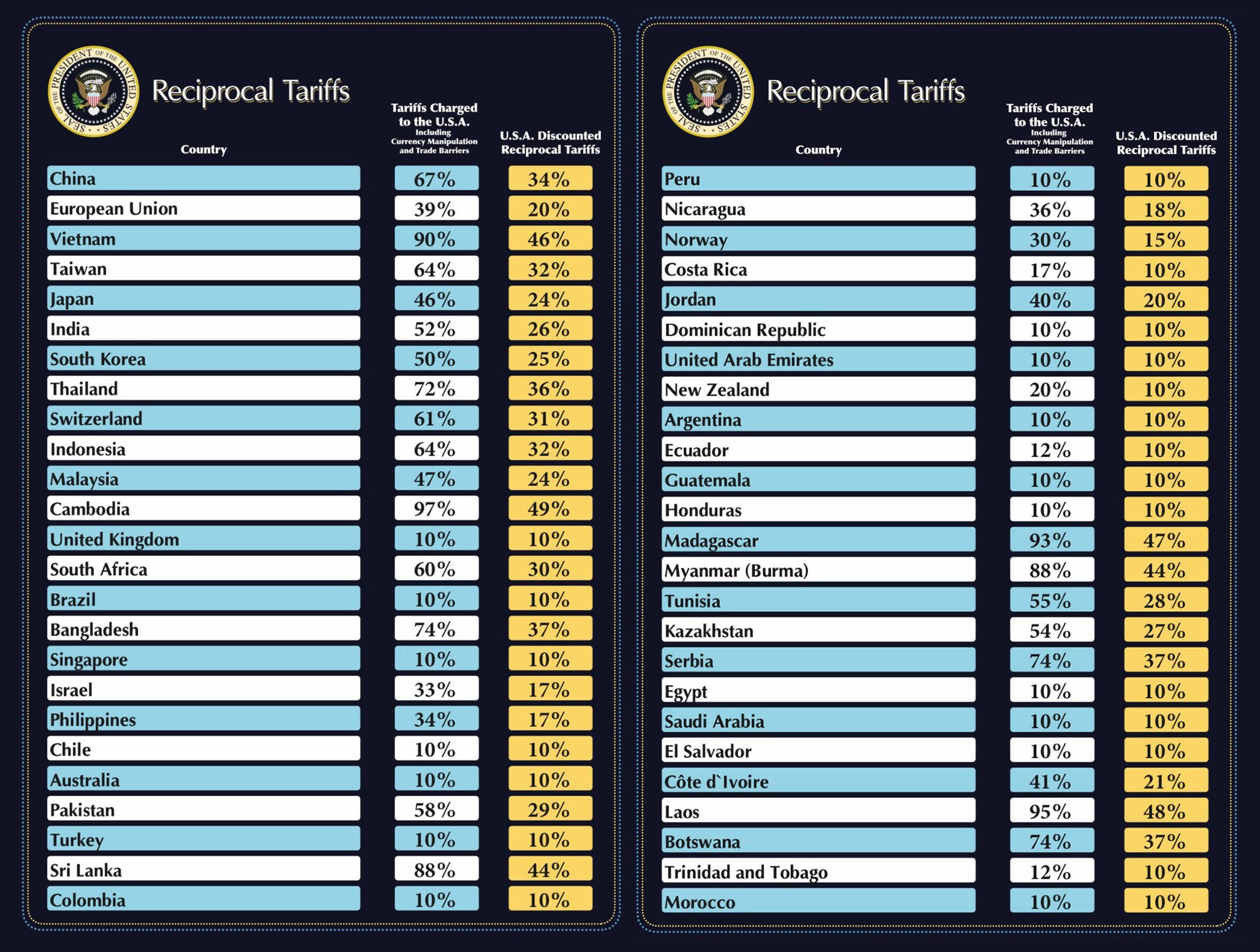
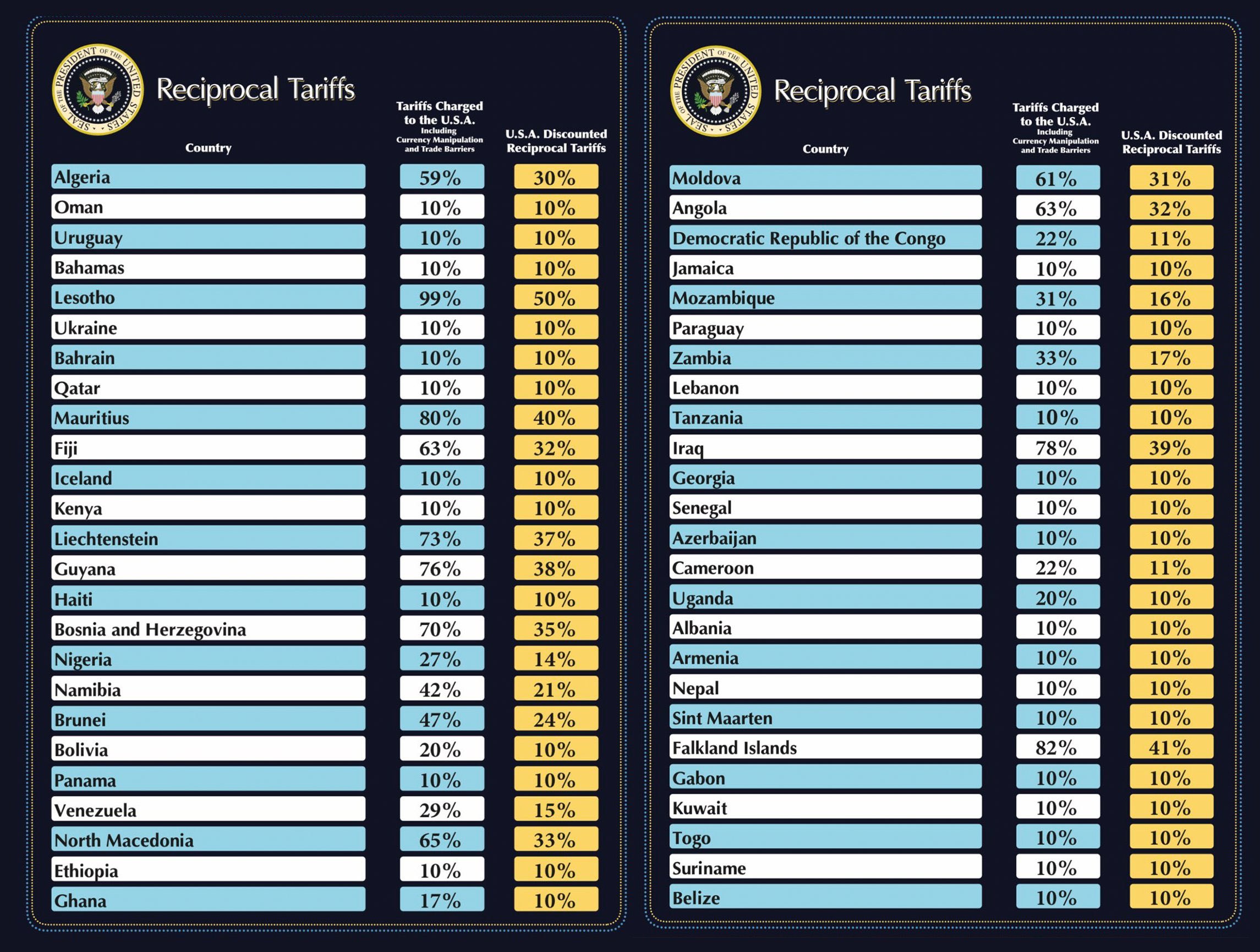
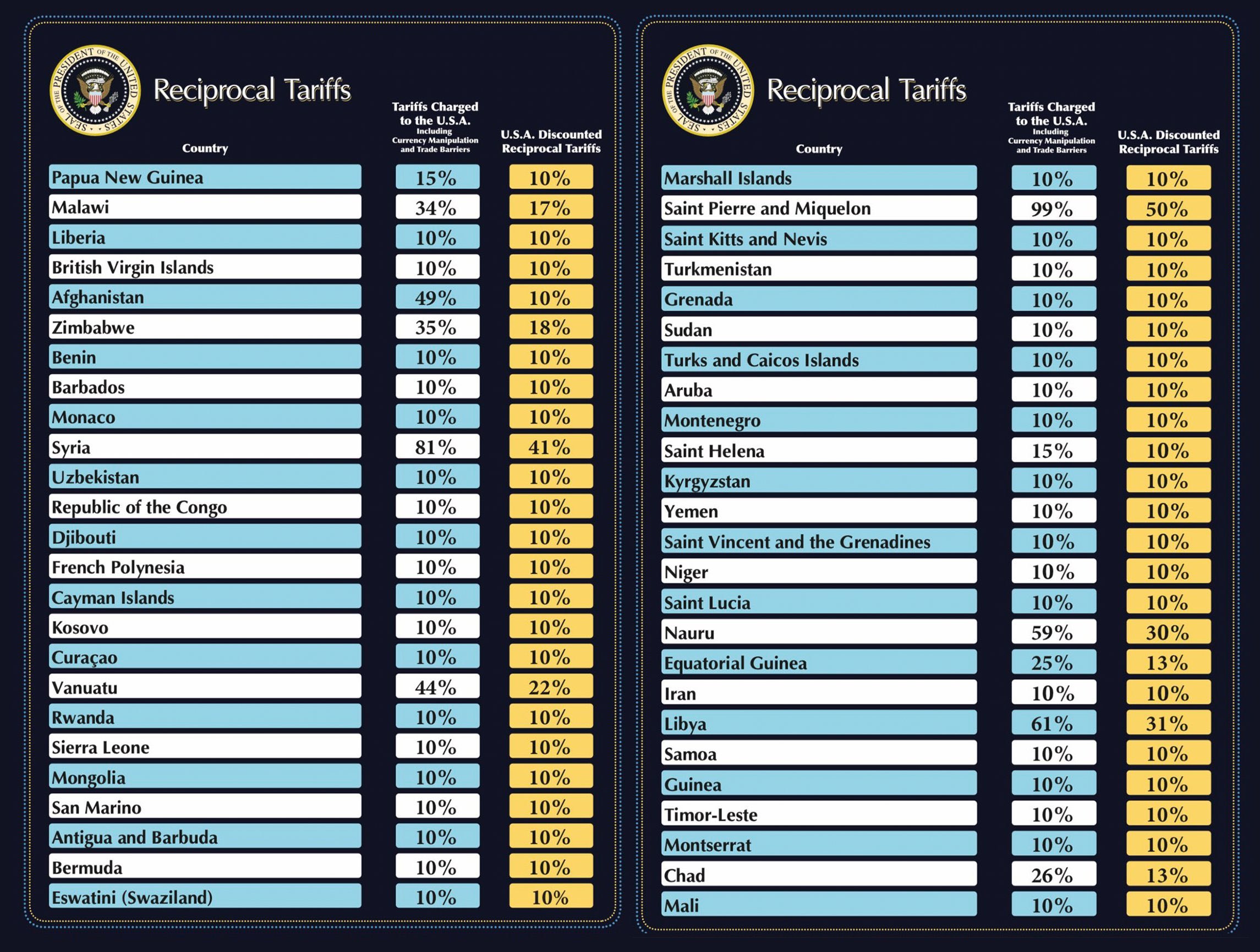
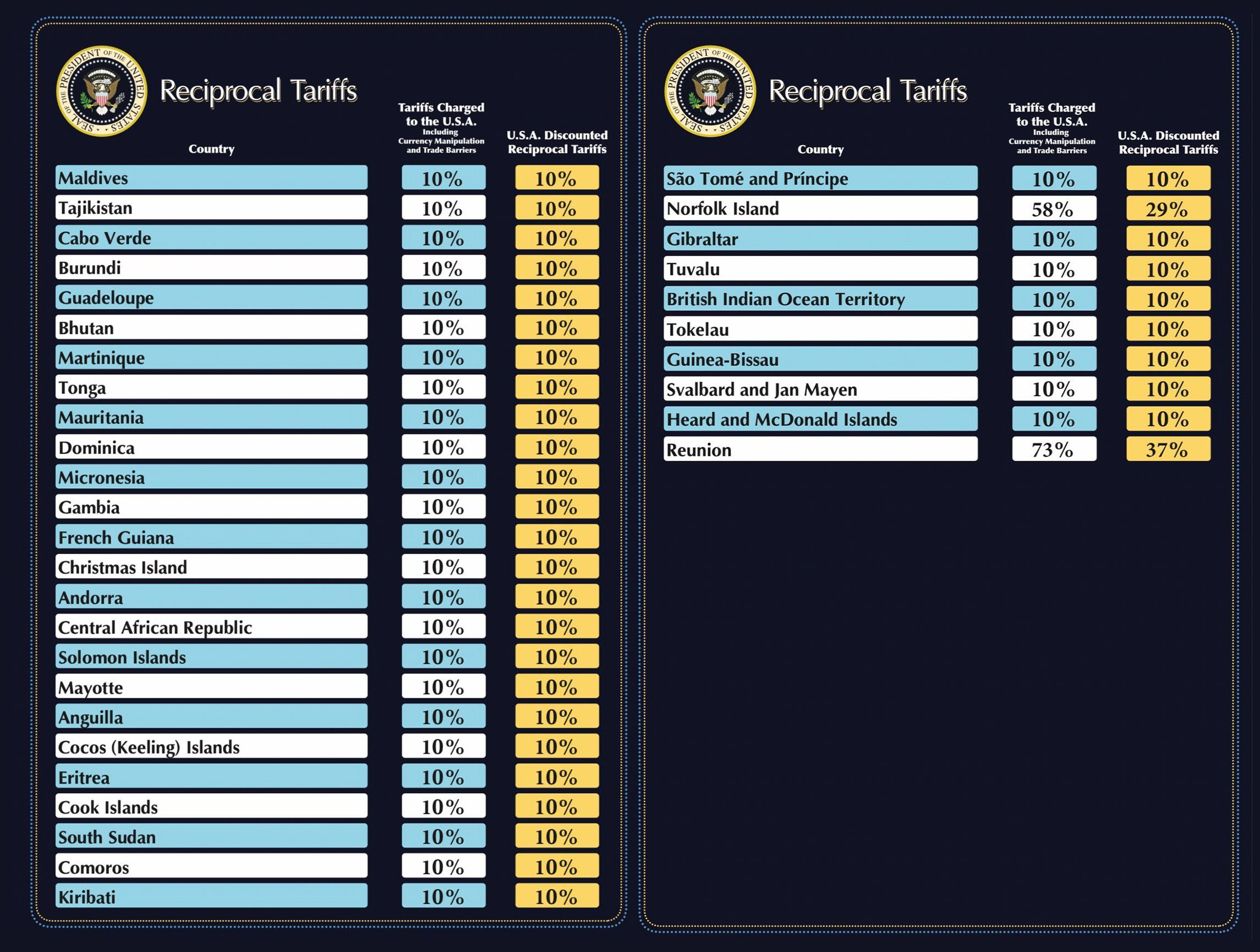
US RECIPROCAL TARIFF (2 APRIL 2025)
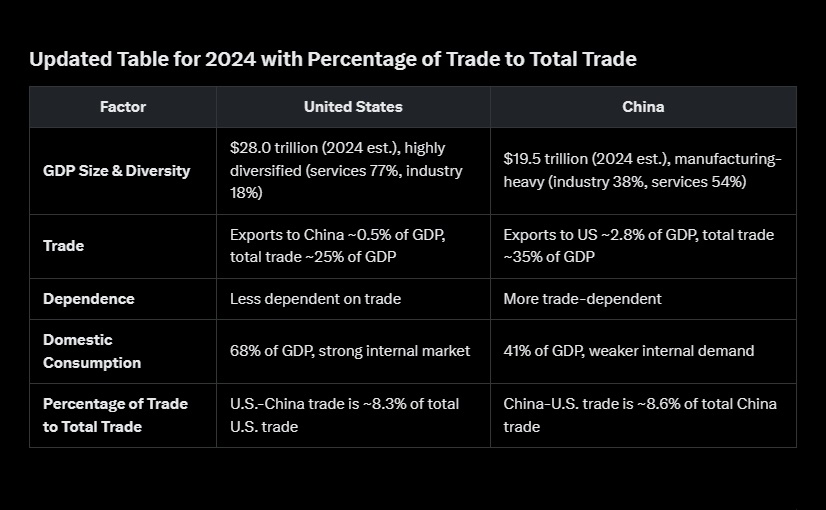
US VS CHINA MATCH UP
Agreed Trade deals with usa
May 9, 2025 - United Kingdom: 10% baseline tariff kept on British products imported to the United States. The agreement lowers 25% universal tariffs on automobiles from the UK to 10%, while the 25% rate still applies to vehicles from other countries. Trump also agreed to eliminate 25% tariffs on steel from the UK. Other details are still in the works.
Offers to USA in Negotiations
April 1, 2025 - Israel: Proposing new trade agreements by eliminating tariffs on U.S. goods, effective April 1, 2025; Prime Minister Benjamin Netanyahu’s push aligns with White House praise from April 8–10, 2025.
April 2, 2025 - Canada: Secured a tariff delay until April 2, 2025 under the USMCA; offering cooperation on fentanyl and trade imbalances, with talks continuing on April 10, 2025 following tariff announcements on April 7, 2025.
April 2, 2025 - Mexico: Under a tariff delay until April 2, 2025 via the USMCA; proposing drug trafficking measures, with negotiations ongoing on April 10, 2025 in response to tariff policy effective April 7, 2025.
April 4, 2025 - Vietnam: Offering zero tariffs on all U.S. goods; Vietnam's leader To Lam proposed this during a call with Trump, with delegations rushing to Washington by April 10, 2025 to finalize terms.
May 9, 2025 - Vietnam:Vietnam had lowered tariffs on American cherries, apples and almonds, all important exports for the country’s western states, confirmed by USA.
April 6, 2025 - Taiwan: Offering zero tariffs on U.S. goods, proposed by April 6, 2025; negotiations ongoing by April 10, 2025 in response to tariff escalation starting April 7, 2025.
April 7, 2025 - India: Open to slashing tariffs on U.S. imports worth $23 billion; negotiations started among the 75+ countries contacting the U.S. since Trump’s tariff policy took effect, continuing into April 10, 2025.
April 8, 2025 - South Korea: Expected to propose tariff cuts and investments (e.g., Hyundai’s $21 billion U.S. plan); Trade Minister Cheong In-kyo met U.S. officials on April 8–9, 2025, with talks ongoing by April 10, 2025.
April 7, 2025 - European Union: Signaling openness to negotiations, offering a "zero-for-zero" tariff deal; counter-tariffs on $28 billion of U.S. goods set for April 15, 2025, in response to U.S. steel tariffs, with talks ongoing since April 7, 2025.
USA Negotiations
April 17, 2025 - Italy: Italian Prime Minister Giorgia Meloni met Trump at the white house. Trump stated he was “100% certain” of a future trade deal with Europe, while Meloni emphasized a “zero-for-zero” tariff approach to avoid a trade war. Meloni invited Trump to visit Italy, which he accepted, but no timeline was set. Conclusion: No deal, waiting for EU-US negotiation.
April 16-17, 2025 - Japan: Japan visits White House. Trump signals he will be negotiating tariff, cost of military support and trade fairness. Japan signals they will not be pressured into unjust trade deals, seeking fairness and diplomacy. Conclusion: No deal, to meet again in late April 2025.
April 9-10, 2025 - Vietnam: Vietnamese Deputy Prime Minister Ho Duc Phoc is on a working trip to the U.S. for tariff-related negotiations, and is expected to meet with Treasury Secretary Scott Bessent.
April 10-12, 2025 - China: Treasury Secretary Scott Bessent and U.S. Trade Representative Jamieson Greer will meet in Geneva with a Chinese delegation led by Vice Premier He Lifeng. Both sides agree to remove tariffs and restrictions since "Liberation Day" for 90 Days. De Minimis duties remained, but reduced.
China Counter Negotiations
April 11, 2025 - Spain: Spanish Prime Minister Pedro Sanchez visits China as the EU rethinks its trade ties following new US import tariffs that have shaken global markets. During his meeting with Spanish Prime Minister Pedro Sanchez, Xi said China and the EU should cooperate more closely to deal with the growing trade tensions between Beijing and Washington
April 14-18, 2025 - Vietnam, Malaysia Cambodia: President Xi Jinping will visit three Southeast Asian countries next week, as China steps up efforts to court partners to buffer the economy against an escalating trade war with the US.
Specific Goods Targeted by Section 301 Tariffs on China
Electronics and Semiconductors:
Semiconductors: 50% tariff effective January 1, 2025 (up from 25% in some cases). Covers 16 tariff categories to support U.S. semiconductor investments under the CHIPS Act.
Wafers for Semiconductor Manufacturing: Proposed 50% tariff (HTS 3818.00.00), as China accounts for 95% of global wafer capacity.
Consumer Electronics: Includes laptops, monitors, smartphones, and video game consoles, many of which have faced tariffs since 2018 but were spared higher rates to avoid consumer price spikes.
Tariff Exclusions: Smartphones, computers, and certain electronics were granted exclusions from the 125% reciprocal tariffs announced in April 2025, sparing them from the steepest duties.
-
Electric Vehicles (EVs) and Batteries:
Electric Vehicles: 100% tariff effective September 27, 2024, to protect U.S. EV manufacturers.
EV Batteries and Battery Parts: 25%–50% tariffs, with some increases phased in for 2025–2026.
Lithium-Ion Non-EV Batteries: Tariff increases planned for 2025–2026 to reduce reliance on Chinese supply chains.
Permanent Magnets: 25% tariff (HTS 8505.11.00), critical for EV motors and defense applications, effective September 2024.
-
Solar Products:
Solar Cells and Modules: 50% tariff effective September 27, 2024, to bolster U.S. solar manufacturing.
Solar Wafers and Polysilicon: Existing 25% tariff increased to 50% effective January 1, 2025, to counter China's dominance in solar supply chains.
Solar Manufacturing Equipment: 14 product-specific exclusions (HTS 8486.10.0000, 8486.20.0000, 8486.40.0030) retroactive from January 1, 2024, to May 31, 2025, to support U.S. solar production. Five proposed exclusions were removed as equipment is available outside China.
Steel and Aluminum Products:
Steel and Aluminum: 25% tariff effective September 27, 2024, building on existing Section 232 tariffs to protect U.S. industries.
Exclusions: Goods already subject to Section 232 tariffs are exempt from the 125% reciprocal tariffs imposed in April 2025.
-
Medical Supplies:
Respirators and Facemasks: 25%–50% tariffs, with increases effective September 27, 2024.
Syringes and Needles: 50% tariff effective September 27, 2024; enteral syringes excluded.
Medical Gloves: Tariff increases planned for 2025–2026.
COVID-Related Exclusions: 77 exclusions for medical products were extended through May 31, 2025, to address supply needs.
-
Critical Minerals and Tungsten:
Critical Minerals: 25% tariff effective September 27, 2024, to reduce U.S. dependence on Chinese minerals.
Tungsten Products: 25% tariff effective January 1, 2025, for products not previously subject to Section 301 tariffs.
Rare Earths: While not explicitly listed in recent updates, China's export restrictions on gallium and germanium highlight their strategic importance, potentially prompting further U.S. tariff actions. [From user's initial request]
-
Machinery and Industrial Goods:
Ship-to-Shore Gantry Cranes: 25% tariff effective September 27, 2024; cranes ordered before May 14, 2024, are excluded.
Machinery for Domestic Manufacturing: Temporary exclusions proposed for 312 HTS subheadings under Chapters 84 and 85, with five additional subheadings added in September 2024. Exclusions are effective through May 31, 2025.
General Industrial Goods: Includes electronics, machinery, furniture, toys, and plastics, with tariffs ranging from 7.5% to 25% since 2018. An additional 10% tariff was proposed in 2025, potentially increasing to 20% or higher if China's Most Favored Nation status is revoked.
-
Apparel, Footwear, and Textiles:
Apparel and Footwear: Subject to tariffs up to 100%, compounded by additional 125% reciprocal tariffs and 20% fentanyl-related tariffs, resulting in effective rates as high as 245% for some goods.
Textiles: Included in List 4A with 7.5% tariffs, with potential increases under new proposals.
SITUATION OVERVIEW
TRADE WARS
USA vs China (ongoing)
China vs European Union (brewing)
USA vs European Union (on temp. hold)
USA vs Canada (on temp. hold)
USA vs Mexico (on temp. hold)
BREWING TRADE TENSION
China vs Japan
China vs South Korea
China vs Australia
China vs Brazil
China vs India
China vs Vietnam
DEMANDS (as of 1 April 2025)
- Reduction of Trade Deficits:
The U.S. seeks to decrease its trade deficits with multiple countries by encouraging increased imports of American goods and services. - Elimination of Non-Tariff Barriers: Beyond tariffs, the U.S. has expressed concerns about non-tariff barriers that hinder American exports. These include foreign regulations, standards, and practices that may disadvantage U.S. products. The administration has sought changes in areas such as value-added taxes (VAT), food safety regulations, and currency valuations to ensure a level playing field for American businesses.
- Addressing Currency Manipulation: The U.S. has raised concerns about countries potentially devaluing their currencies to gain unfair trade advantages. By addressing such practices, the administration seeks to promote fair competition in international markets.
- Reciprocal Tariffs: The U.S. aims to implement tariffs that mirror those imposed by other countries, advocating for "reciprocal" trade relationships. This approach is intended to pressure trading partners into reducing their tariffs and trade barriers to match U.S. levels.
KEYSTONE DEVELOPMENT (9 May 2025)
President Donald Trump said that the U.S. will maintain a baseline 10% tariff on imports even after trade deals are struck, adding there could be exemptions when countries offer significant trade terms.
DEVELOPMENT (16 May 2025)
Moody’s had been a holdout in keeping U.S. sovereign debt at the highest credit rating possible, and brings the 116-year-old agency into line with its rivals. Standard & Poor’s downgraded the U.S. to AA+ from AAA in August 2011, and Fitch Ratings also cut the U.S. rating to AA+ from AAA, in August 2023.
The U.S. lost its perfect AAA rating from all three major agencies (S&P, Moody’s, Fitch) for the first time in over a century, with Moody’s downgrade in May 2025 marking the final shift.
“Successive U.S. administrations and Congress have failed to agree on measures to reverse the trend of large annual fiscal deficits and growing interest costs,” Moody’s analysts said in a statement.“We do not believe that material multi-year reductions in mandatory spending and deficits will result from current fiscal proposals under consideration.”
"The US' long-term local- and foreign-currency country ceilings remain at Aaa."
Read Moody's full Press Release: https://ratings.moodys.com/ratings-news/443154
DEVELOPMENT (13 May 2025)
Consumer prices climbed last month at the slowest pace since February 2021, as the inflationary effects of President Donald Trump's tariffs had yet to hit Americans' wallets.
Analysts said the slower price growth may still not prompt the Federal Reserve, which is tasked with managing inflation, from lowering interest rates. Trump has repeatedly called for the central bank to do so, bashing its decision last week to hold rates steady.
KEYSTONE DEVELOPMENT (9 May 2025)
Agreement in principle provides significant expansion in U.S. market access in the UK, with reduction in tariff for UK automobiles, steel and aluminum.
- negotiate a digital trade provisions
- secures the supply chain of U.S. aerospace manufacturers through preferential access to high-quality UK aerospace components.
- secure supply chain for pharmaceutical products.
- close loopholes in the UK’s government procurement market that harm U.S. and UK firms.
- give each other preferential procurement access to which other countries are not entitled.
- US tariffs on automotives immediately slashed from 27.5% to 10%: first 100,000 vehicles imported into the United States by UK car manufacturers each year are subject to an all-in rate of 10% and any additional vehicles each year are subject to 25% rates on top of the Most Favored Nation tariff. Quota is almost the total the UK exported in 2024.
- Negotiate an alternative arrangement to USA's Section 232 tariffs on steel and aluminum: effectively reduced to zero
- Reciprocal market access on beef – with UK farmers given a quota for 13,000 metric tonnes.
USA however is disappointed that UK refused to remove the Digital Services Tax (DST).
KEYSTONE DEVELOPMENT
Federal Register filings reveal probes into imports of pharmaceuticals and semiconductors as part of a bid to impose tariffs on both sectors on grounds that extensive reliance on foreign production of medicine and chips is a national security threat.
The filings announce 21-day public comment periods and mark President Donald Trump's latest use of Section 232 of the Trade Expansion Act of 1962 as justification for so-called sectoral tariffs aimed at boosting domestic production of goods he says are critical to national security.
Using the 232 provision, the Trump administration has started investigations into imports of copper and lumber, and probes completed during Trump's first term formed the basis for 25% tariffs rolled out since his return to the White House in January on steel and aluminum and on the auto industry.
The filings, which indicate the administration began the investigations on April 1, follow exclusions unveiled over the weekend for smartphones, computers and other electronics imported largely from China from Trump's steep 125% reciprocal duties. Trump officials had said those products would soon be subject to Section 232 tariffs.
Section 232 probes need to be completed within 270 days of their initiation. (source)
Foreshadowing of future actions
"All those products are going to come under semiconductors, and they're going to have a special focus type of tariff to make sure that those products get reshored.
We need to have semiconductors, we need to have chips, and we need to have flat panels -- we need to have these things made in America. We can't be reliant on Southeast Asia for all of the things that operate for us
So what [President Donald Trump's] doing is he's saying they're exempt from the reciprocal tariffs, but they're included in the semiconductor tariffs, which are coming in probably a month or two. So these are coming soon."
United States of America
... told ABC News, the exemptions for electronics are only a temporary reprieve. Those products will face separate levies
This, he stressed, would not only “safeguard their own legitimate rights and interests, but also… safeguard international fairness and justice.”
KEYSTONE DEVELOPMENT (5 May 2025)
Malaysia’s Ministry of Investment, Trade and Industry (Miti) announced on May 5 that with effect from May 6, it will be the only body that will issue non-preferential certificates of origin (NPCOs) for shipments to the US, stopping the issuance of these certificates by Miti-appointed organisations like local business councils, chambers or associations.
The NPCO is a document that helps to identify the origin of goods for international shipments in order to satisfy Customs or trade requirements of the countries the products are shipped to, the Federation of Malaysian Manufacturers said on its website.The government’s new measure aims to eliminate loopholes that could enable the misuse of Malaysia as a conduit for goods seeking to bypass tariffs imposed by US trade regulations. Miti said in its statement that “it is unequivocally committed to upholding the integrity of international trade practices”.
“As such, the government views any attempt to circumvent tariffs through wrong or false declaration, whether related to the value or origin of goods, as a serious offence,” it added.
Addressing the matter in Parliament on May 5, Investment, Trade and Industry Minister Tengku Zafrul Aziz said: “For countries with no free trade agreements with Malaysia, like the US, we have an NPCO which is issued by business chambers, but due to this (trans-shipment) issue, Miti will take over the issuance of these certificates.”
He added that Malaysia has received “many complaints from industry partners” that “many items coming from other countries are stamped as if they come from our country”.
KEYSTONE DEVELOPMENT
India and the US have finalised the terms of reference outlining the roadmap for negotiations of the proposed Bilateral Trade Agreement (BTA), according to a statement issued by the US.
US Trade Representative (USTR) Jamieson Greer said that these ongoing talks will help achieve balance and reciprocity by opening new markets for American goods and addressing unfair practices that harm US workers.
"India's constructive engagement so far has been welcomed, and I look forward to creating new opportunities for workers, farmers, and entrepreneurs in both countries," he said in a statement.
"I am pleased to confirm that USTR and India's Ministry of Commerce and Industry have finalised the Terms of Reference to lay down a roadmap for the negotiations on reciprocal trade," Ambassador Greer said.
KEYSTONE DEVELOPMENT
The U.S. Department of Commerce (DOC) concluded a trade probe that began a year ago when several major solar equipment producers asked the administration of then-President Joe Biden to protect their US operations.
A separate US government agency, the International Trade Commission, is due to reach a final decision on the new tariffs in June.
The probe targeted crystalline silicon photovoltaic (PV) cells and modules, key components of solar panels, exported from these Southeast Asian countries, which account for a significant share of U.S. solar imports.
Findings confirmed subsidies (e.g., tax breaks, low-cost loans) and dumping margins, justifying anti-dumping (AD) and countervailing duties (CVD) to level the playing field for U.S. producers.
Cambodia: Faces the highest duties at up to 3,521%, effectively blocking most solar exports to the U.S. This rate reflects the DOC’s calculation of severe dumping and subsidy levels, likely tied to specific Cambodian firms or supply chains linked to Chinese manufacturers.
Vietnam: Duties up to 395.9%, targeting major exporters like Trina Solar and JinkoSolar, which have production facilities in Vietnam. The high rate aims to curb Vietnam’s role as a transshipment hub for Chinese solar components.
Thailand: Duties up to 375.2%, impacting firms like Canadian Solar operating in Thailand. The rate reflects significant dumping margins and subsidies, though lower than Cambodia and Vietnam.
Malaysia: Lowest duties at up to 34.4%, affecting companies like First Solar. Malaysia’s lower rate suggests less aggressive subsidy or dumping practices compared to its neighbors.
Duties vary by company and product, with preliminary rates subject to final DOC review in mid-2025. Rates are applied to the import value, drastically raising costs for U.S. importers.
Point of view
"At the end of the day that we can probably reach a deal with our allies... and then we can approach China as a group."
United States of America
... spoke with investors Tuesday morning at a summit hosted by the American Bankers Association, warning Spain and any other countries from thinking that aligning themselves with China is a solution against the United States.
USA vs china (2025)
January 20, 2025: Trump begins his second term. Tariffs on Chinese imports are raised to 20% early in the administration.
February 4, 2025: Trump signs executive orders imposing additional tariffs, including 10% on all Chinese imports (later escalated). China responds with 15% tariffs on U.S. coal and liquefied natural gas, and 10% on crude oil and agricultural machinery.
March 4, 2025: Trump doubles tariffs on Chinese imports to 20%. China retaliates with 15% tariffs on U.S. farm products like chicken, pork, and soybeans.
April 2, 2025: U.S. President Donald Trump announces a significant escalation, raising tariffs on all Chinese imports by an additional 34%, bringing the total tariff rate to 54% (stacked on top of the 20% imposed earlier in 2025). Dubbed "Liberation Day" by Trump, this move is framed as a reciprocal response to alleged Chinese trade barriers. China vows retaliation, signaling no intent to back down.
Trump announced proper protocol was in place to collect revenue on small-value packages sent through the international postal network. From May 2nd, Postal packages from China valued at under $800 will then be taxed at 90% of their value or $75 per item, which is scheduled to increase to $150 per item after June 1.
April 4, 2025: China responds with its own 34% tariffs on all U.S. imports, effective April 10, matching the U.S. escalation. Beijing also imposes export restrictions on rare earth elements critical for tech and defense industries, bans several U.S. companies from operating in China, and launches trade investigations into American exports like medical imaging equipment.
April 7, 2025: Trump threatens an additional 50% tariff on Chinese goods, to take effect April 9, unless China withdraws its 34% retaliatory tariffs by April 8. China’s Ministry of Commerce declares it will "fight to the end," rejecting the ultimatum and accusing the U.S. of economic bullying. Global markets react with sharp declines, with the S&P 500 dropping over 9% for the week.
April 9, 2025: The U.S. implements the additional 50% tariff as promised, raising the total tariff rate on Chinese imports to 104% (20% from February, 34% from April 2, plus 50% today). This marks the highest tariff level in modern U.S.-China trade history.
China in response had also raised another 50% tariff, mirroring US tariff action, increasing retaliatory tariff from 34% to 84%
Trump immediately counter attacked on China’s increase of retaliatory tariff to 84% with an immediate increase of tariff on China to 125% on the same day.
While at the same time, Trump, upon achieving the goal of getting countries onto the negotiating table, the 75 countries that called USA to negotiate on the tariffs will now receive a 90 day reprieve from the announced tariff and will only be tariffed at 10% – the minimum import tariff set for all countries on Trump’s “Liberation Day”.
April 10, 2025: China reach out to other countries/blocs in attempt to form a united front against USA. These includes, Australia, European Union, ASEAN and India. Australia and India had turned down China's call for cooperation.
EU and ASEAN spoke, but no agreements had been announced yet.
USA clarified that the effective tariff on China is actually 145%: 125% tariff + 20% tariff in regards to the fentanyl crisis.
April 11, 2025: China raise tariff on US goods from 84% to 125% from April 12, 2025.
Chinese President Xi Jinping met with Spanish Prime Minister Pedro Sanchez in Beijing, and announced state visit to Vietnam from April 14 to 15, and then Malaysia and Cambodia from April 15 to 18.
China's General Administration of Customs has changed its rules of how the origin of imported chips must be classified, now deeming that the wafer fabrication location should be counted as the origin of chips shipped to the country.
April 14, 2025: Confirmation that China is no longer exporting seven heavy rare earth metals processed exclusively in the Asian power, as well as heavy rare earth magnets — of which about 90% of the world’s supply are also synthesized on Beijing’s territory, in the April 3-4 export restriction announcement.
The export halt applies to all countries, but access to elements like dysprosium and yttrium are critical to US industry — especially in the tech, electric vehicle, aircraft and defense sectors (source)
China President Xi Jinping visit Vietnam: Over 40 cooperation agreements were signed, focusing on trade, supply chains, and infrastructure, though specific financial commitments were not disclosed.
April 15, 2025: Nvidia said it was informed by the U.S. government that it will need a license to export its H20 AI chips to China. This license will be required indefinitely, according to the filing — the U.S. government cited “risk that the [H20] may be used in […] a supercomputer in China.”
Chinese government has told the country's domestic airlines to stop accepting deliveries of Boeing jets and also instructing its carriers to stop buying airline parts and other components from U.S. companies.
April 16, 2025: Hong Kong Post say it had suspended goods mail services by sea to the United States and will suspend its air mail postal service for items containing goods from April 27 due to "bullying" U.S. tariffs.
U.S. announce tariff up to 245%, but media reported "increase tariffs to 245%" on Chinese goods - Clarification from the white house: "This includes a 125% reciprocal tariff, a 20% tariff to address the fentanyl crisis, and Section 301 tariffs on specific goods, between 7.5% and 100%."
April 17, 2025: China's government appointed a new trade negotiator, Li Chenggang to replace Wang Shouwen, who participated in negotiations for the countries' 2020 trade deal.
The U.S. Trade Representative (USTR) introduced a new maritime fee structure in April 2025 to counter China's dominance in the maritime, logistics, and shipbuilding sectors while promoting U.S. shipbuilding. The initiative stems from a Section 301 investigation.
April 23, 2025: USA's Department of Commerce concludes trade probe over solar panel related imports, plans to impose tariffs of up to 3,521% on solar panels import from Cambodia, Vietnam, Thailand and Malaysia. Tariffs are largely targeting Chinese companies and transshipments.
April 24, 2025: China quietly exempted eight tariff codes for U.S.-made semiconductors and integrated circuits, as well as certain U.S.-made pharmaceuticals from 125% tariffs, with specific drugs or categories not publicly detailed, from 125% retaliatory tariffs, reducing the rate to 0%.
April 25, 2025: China directed businesses to identify additional “critical goods” for potential future tariff exemptions, with a Ministry of Commerce taskforce collecting lists from companies. Held a Ministry of Commerce roundtable with over 80 foreign firms and chambers to discuss U.S. tariff impacts and gather input on essential imports needing levy-free status.
Censored a Caijing magazine report detailing semiconductor exemptions, removing it three hours after publication to maintain secrecy.
May 2, 2025: China quietly exempts approximately $40 billion worth of U.S. imports from its retaliatory tariffs (125% on U.S. goods), covering about one-quarter of U.S. imports. The exempted goods include pharmaceuticals, microchips, and jet engines, aimed at softening the trade war’s impact on China’s economy.
May 10, 2025: Treasury Secretary Scott Bessent and U.S. Trade Representative Jamieson Greer will meet in Geneva with a Chinese delegation led by Vice Premier He Lifeng.
May 12, 2025: USA-China reduce reciprocal/retaliation tariffs to 10% as well as any retaliatory actions by China for 90 Days. This however does not include industry specific tariffs by USA as well as the 20% tariff relating to Fentanyl crisis. De Minimis duty drops from 120% to 54%, but $100 per-postal-item duty remains remains without $150 increase.
KEYSTONE DEVELOPMENT
The U.S. Trade Representative (USTR) introduced a new maritime fee structure in April 2025 to counter China's dominance in the maritime, logistics, and shipbuilding sectors while promoting U.S. shipbuilding.
The initiative stems from a Section 301 investigation, prompted by five U.S. labor unions in March 2024, which concluded that China’s state subsidies and policies unfairly bolster its maritime industry, capturing over 50% of global shipbuilding by 2023.
-
Counter Chinese Dominance: Address China’s market share growth from 5% in 1999 to over 50% in 2023, driven by subsidies and state-backed enterprises, which the USTR deems harmful to U.S. commerce.
-
Revive U.S. Shipbuilding: Stimulate domestic shipyard activity, which has dwindled to producing about five vessels annually compared to China’s 1,700.
-
Economic and Security Benefits: Strengthen U.S. maritime infrastructure, create jobs, and enhance national security by reducing reliance on foreign shipbuilding.
Read more: Full Fee Structure and information
KEYSTONE DEVELOPMENT
Postal packages from China valued at under $800 will then be taxed at 90% of their value or $75 per item, which is scheduled to increase to $150 per item after June 1.
Point of view
"China firmly opposes any party reaching a deal at the expense of China’s interests. If such a situation arises, China will not accept it and will resolutely take reciprocal countermeasures."
People's Republic of China
... commenting on recent media reports about the Trump administration’s plans to pressure countries into restricting trade with China in exchange for exemptions from US tariffs.
Adding, "Appeasement does not bring peace, and compromise does not earn respect.”
“Seeking temporary self-interest at the expense of others — in exchange for so-called exemptions — is like asking a tiger for its skin. In the end, it will achieve nothing and harm both others and oneself.”
China vs World (minus USA) since 2020
January 1, 2020: India introduced tariffs of 15–30% on Chinese electronics, toys, and chemicals under the “Make in India” initiative
May 18, 2020: China imposed 73.6% anti-dumping duty and 6.9% anti-subsidy duty, totaling 80.5% on Australian barley for five years.
October 12, 2020: China suspended imports of Australian cotton and restricted other goods (e.g., timber, lobster) through non-tariff barriers like customs delays and inspections, impacting AUD 300–400 million in exports.
November 28, 2020: China imposed on Australian wine anti-dumping tariffs of provisional duties of 107–212% (averaging 169%).
December 16, 2020: China effectively banned Australian coal imports. No formal tariff was announced, but China imposed an informal ban through verbal directives to state-owned enterprises, halting imports of Australian thermal and coking coal.
March 26, 2021: China finalised Australian wine anti-dumping tariffs of duties of 116–218% duties for five years. (Crushed Australia’s AUD 1.1 billion wine export market to China (40% of total wine exports), dropping to near zero by 2021.)
April 1, 2022: European Union extended anti-dumping duties of 21–42% on Chinese aluminum products, originally imposed on October 15, 2010, through 2024.
January 1, 2023: Canada extended anti-dumping duties of 20–40% on Chinese carbon steel fasteners, originally imposed on September 2, 2005, through 2024.
March 1, 2022: South Africa extended anti-dumping duties of 15–25% on Chinese glass products, originally imposed on April 20, 2018, through 2024.
May 1, 2022: Mexico applied anti-dumping duties of 25–35% on Chinese textiles and apparel, following complaints about market flooding.
June 1, 2022:Australia Applied anti-dumping duties of 10–20% on Chinese solar panel components, extended from measures first imposed on August 22, 2017.
July 1, 2022: Chile extended anti-dumping duties of 10–20% on Chinese steel grinding balls, originally imposed on June 10, 2018.
February 1, 2023: Colombia extended anti-dumping duties of 20% on Chinese ceramic tiles, originally imposed on March 15, 2020, through 2024.
February 14, 2023: China began allowing Australian coal imports informally in January 2023, with significant volumes resuming by February 14, 2023, after diplomatic engagements. No formal tariff was lifted, as the ban relied on non-tariff measures.
March 1, 2023: European Union Applied anti-subsidy duties of 10–20% on Chinese solar panels and components, extended from duties first imposed on December 5, 2013.
Brazil extended anti-dumping duties of 14–20% on Chinese footwear and textiles, originally imposed on April 15, 2019, through 2024.
April 1, 2023: Indonesia applied tariffs of 10–20% on Chinese textiles and garments, extended from measures first imposed on July 1, 2020.
June 1, 2023: China imposed stricter sanitary inspections on Brazilian beef and soybean exports, indirectly retaliating against Brazil’s footwear and textile tariffs.
July 1, 2023: Vietnam applied temporary anti-dumping duties of 15–20% on Chinese aluminum extrusions, following complaints about market distortions.
China extended export controls on dual-use technologies (e.g., semiconductors, aerospace components) to EU firms, citing national security, partly in response to EU aluminum and solar panel tariffs.
July 15, 2023: China imposed anti-dumping duties of 10–15% on Indian chemical exports, such as certain polymers and petrochemicals, in response to India’s broader tariffs on Chinese goods, including electronics and chemicals.
August 1, 2023:Turkey extended tariffs of 15–25% on Chinese machinery and electronics, originally imposed on September 10, 2019, through 2024.
China imposed export license requirements for gallium and germanium, critical for semiconductors and electronics, impacted the EU, which relied on China for 71% of gallium and 45% of germanium imports in 2023. These measures strained EU high-tech industries (e.g., solar products, fiber optics).
August 5, 2023: China lifted the 80.5% tariffs on Australian barley, effective immediately, restoring market access for AUD 1.2 billion in exports. This followed improved bilateral talks and Australia’s decision to pause WTO disputes.
December 1, 2023: China implemented stricter controls on high-purity graphite, used in EV batteries and renewable energy storage, effective December 1, 2023, following an announcement in October 2023. These controls required export licenses and impacted EU industries, as China supplied 65.6% of EU graphite imports in 2024.
March 29, 2024:China fully lifted the 116–218% tariffs on Australian wine, effective March 29, 2024, following the October 2023 review, restoring AUD 1.1 billion in exports
May 5, 2024: Chile imposed tariffs of 15% on Chinese steel bars and rods to protect domestic industry.
June 1, 2024: China increased inspections on Chilean copper exports, a critical sector, as an indirect response to Chile’s steel tariffs. No direct tariffs were imposed.
June 10, 2024: Colombia imposed tariffs of 10–15% on Chinese steel wire and cables to counter subsidized exports.
June 15, 2024: European Union extended anti-dumping duties of 19–36% on Chinese steel products (hot-rolled and cold-rolled steel), originally imposed on February 10, 2017, through 2024.
July 1, 2024: Australia imposed anti-dumping duties of 15–25% on Chinese wind towers and steel reinforcing bars to address unfair trade practices.
July 20, 2024: Turkey imposed anti-dumping duties of 20–30% on Chinese solar panels and modules to protect domestic renewable energy industries.
August 10, 2024: China launched an anti-subsidy investigation into EU dairy products (e.g., cheese, milk), threatening tariffs of up to 20%, in retaliation for the EU’s steel and solar panel duties. No tariffs were imposed by the end of 2024.
August 12, 2024: India imposed anti-dumping duties of up to 20% on certain Chinese steel products, including flat-rolled steel, to protect domestic producers from cheap imports.
August 15, 2024: China launched an anti-dumping investigation into Turkish textile exports, threatening duties of up to 20%, in response to Turkey’s solar panel tariffs. No tariffs were imposed by the end of 2024.
August 20, 2024: Mexico Imposed tariffs of 15–20% on Chinese steel products, including seamless steel pipes, to protect local industry.
September 10, 2024: Brazil imposed tariffs of 12–18% on Chinese steel products, including steel plates and wire rods, to counter low-cost imports.
September 15, 2024: China imposed stricter customs regulations on Mexican auto parts exports, indirectly responding to Mexico’s steel tariffs. No direct tariffs were documented.
China introduced export controls on antimony, a critical mineral used in flame retardants, batteries, and military applications (e.g., night vision devices). Announced on August 15, 2024, and effective September 15, 2024, these restrictions required export licenses, impacting EU supply chains.
October 1, 2024: Canada imposed a 100% surtax on Chinese electric vehicles to counter subsidized imports, aligning with U.S. measures.
China implemented comprehensive regulations on rare earth resources, requiring export licenses for rare earth products (including lanthanum, cerium, praseodymium, neodymium, samarium, gadolinium, terbium, dysprosium, etc.) and established a traceability system for mining, refining, and export activities
Russia on October 1st, 2024, raised significant recycling/utilization fee hike on Chinese vehicles. These fees, a one-time charge for future vehicle disposal, were raised by 70-85% depending on engine size, and from January 2025, fees for Chinese carmakers add over $7,000 for vehicles with 1-2L engines and nearly $20,000 for larger vehicles, on top of a 15% import tariff. Fees are set to rise by 10-20% annually until 2030.
October 5, 2024: Indonesia imposed anti-dumping duties of 15–25% on Chinese cold-rolled stainless steel to protect local manufacturers.
October 15, 2024: Canada imposed a 25% surtax on Chinese steel and aluminum products to protect domestic industries.
China launched an anti-dumping investigation into Brazilian poultry exports, threatening duties of up to 15%, in response to Brazil’s steel tariffs. No tariffs were imposed by the end of 2024.
Russia issued the Directive No. 1374, which expanded the list of banned transit goods banned from transit through Russia (primarily from China), focusing on dual-use items—products like electronics, machinery, and certain textiles (e.g., camouflage clothing) that could have military applications.
October 19, 2024: China Premier Li Qiang has signed a decree of the State Council to unveil regulations on export control of so-called dual use items, which will take effect on Dec. 1, 2024.
October 20, 2024: China launched an anti-subsidy probe into Canadian lumber exports, threatening tariffs of up to 15%, as a countermeasure to Canada’s steel and aluminum surtaxes.
October 30, 2024: European Union Imposed provisional anti-dumping duties of 17–38.1% on Chinese electric vehicles (EVs) following subsidy investigations, set to be finalized in 2025 if negotiations failed.
November 1, 2024: South Africa imposed tariffs of 10–20% on Chinese steel products, including structural steel, to counter subsidized imports.
China imposed anti-dumping duties of 10–20% on Canadian canola oil exports in response to Canada’s EV and steel tariffs. This followed a September 3, 2024, investigation announcement.
November 8, 2024: China imposed anti-dumping duties of 15–30% on EU brandy exports (e.g., French cognac), targeting a politically sensitive sector in France, in direct response to the EU’s EV tariffs.
November 10, 2024: China imposed stricter customs procedures on Indonesian palm oil exports, indirectly responding to Indonesia’s steel tariffs. No direct tariffs were documented.
November 15, 2024: Vietnam imposed anti-dumping duties of 10–25% on Chinese welded steel pipes and tubes to safeguard domestic manufacturers.
December 1, 2024: China imposed stricter customs inspections and non-tariff barriers on Vietnamese agricultural exports (e.g., seafood, rice), indirectly responding to Vietnam’s steel and aluminum tariffs. No direct tariffs were documented.
December 5, 2024: China imposed stricter customs inspections on South African mineral exports (e.g., iron ore), indirectly responding to steel tariffs. No direct tariffs were documented.
2025:
January 1st, 2025: Russia also imposed import tariff of 20-38% on automobiles, which would impact Chinese vehicle makers most directly as China vehicles had dominated Russian market since the withdrawal of European car makers, to protect Russian domestic brands like Avtovaz.
March 7, 2025: Vietnam impose temporary anti-dumping duties of up to 27.83% on certain Chinese steel products to protect domestic industry.
April 1, 2025:India impose 12% temporary tariff on steel imports to counter cheap Chinese steel. Protects domestic producers from China’s subsidized exports.
European Union reduced steel import quotas by 15% to limit inflows of Chinese steel, protecting EU steelmakers from subsidized imports; imposed anti-subsidy duties on top of existing anti-dumping duties on Chinese mobile access equipment, addressing unfair subsidies (e.g., cheap land, tax breaks).
Vietnam strengthened controls on Chinese goods transshipped through Vietnam to avoid U.S. tariffs, increasing costs for Chinese exporters
April 15, 2025: Vietnam’s trade ministry has issued a directive to crack down on illegal transshipment of goods to the United States and other trading partners. Supervision and inspection to be strengthened on imported goods to establish their origin, “especially imported raw materials used for production and export”. New stricter procedures are to be implemented to inspect factories and supervise the release of “Made in Vietnam” labels, “especially for enterprises with a sudden increase in the number of applications for certificates of origin,
April 20, 2025: Brazil introduced a 15% tariff on Chinese textiles and apparel to protect its domestic manufacturers from low-cost imports.
April 25, 2025: Australia applies preliminary anti-dumping duties of up to 20% on Chinese solar panels to address unfair pricing practices and protect the renewable energy sector.
May 5, 2025: Malaysia acknowledged reports of it being used as a transshipment hub for Chinese goods, initiated preliminary investigations to address transshipment practises.
Rest of the World
April 9, 2025: India terminated the transshipment facility that allowed export cargo from Bangladesh to third countries using Indian land customs stations en route to ports and airports. The facility had enabled smooth trade flows for Bangladesh's exports to countries like Bhutan, Nepal, and Myanmar. It was provided by India to Bangladesh in June 2020.
The decision comes against the backdrop of the recent comments made by Bangladesh Chief Adviser Muhammad Yunus on India's northeastern states.
Yunus while addressing a programme apparently in China, has purportedly stated that India has seven landlocked states in its eastern part known as seven sisters and "they have no way to reach the ocean. We are the guardian of the ocean (Bay of Bengal)". He also invited China to send goods through it across the world.
KEYSTONE DEVELOPMENT (28 April 2025)
The European Commission said it had imposed duties of up to 66.7% on imports of Chinese machines that lift construction workers after concluding that the producers were benefiting from unfair subsidies and selling at artificially low prices.
The extra duties on Chinese mobile access equipment (MAE) will range from 20.6% to 66.7%, the Commission said, as it sought to protect domestic producers in the EU market worth more than 1 billion euros ($1.14 billion) per year.
The EU executive, which conducted the investigation, said Chinese MAE producers had benefited from preferential financing, grants, state provision of inputs at below-market rates.
The Commission said Chinese producers had gained a 41% market share in the year from October 2022, from 29% in 2020, and sold at prices some 20% below EU competitors.
The tariffs will apply to Chinese companies such as Hunan Sinoboom Intelligent Equipment Co, Zoomlion Intelligent Access Machinery and Zhejiang Dingli Machinery Co. EU MAE producers include French companies Haulotte and Manitou.
The European Union now has in place anti-dumping or anti-subsidy duties on almost 80 Chinese products from truck tyres to ironing boards.
European Union vs China
January 7, 2025: EU trade commissioner Maroš Šefčovič announces enhanced import monitoring for Chinese steel and electronics, citing risks of trade diversion from U.S. tariffs (104% on Chinese goods).
February 3, 2025: China’s commerce ministry extends anti-dumping probes into EU dairy, adding pressure on Ireland and the Netherlands, in response to EU EV tariffs (25-35%).
February 14, 2025: European Central Bank releases a report estimating a potential 0.14-0.2% EU GDP drop if U.S.-China trade war escalates, urging stronger trade defenses against Chinese overcapacity.
March 10, 2025: China imposes preliminary 15% tariffs on EU wine imports, escalating retaliation for EU EV tariffs.
March 27, 2025: China’s Vice Premier He Lifeng meets EU trade chief Maroš Šefčovič in Beijing, proposing joint resistance to U.S. protectionism and offering EV tariff concessions; EU remains cautious, prioritizing market fairness.
April 2, 2025: EU Commission launches a review of Chinese battery imports, suspecting state subsidies, amid fears of U.S. tariff-driven trade diversion.
April 10, 2025: China’s commerce ministry confirms 84% tariffs on U.S. goods (up from 34%), prompting EU concerns about redirected Chinese exports flooding European markets.
April 11, 2025: European Commission President Ursula von der Leyen speaks with Chinese Premier Li Qiang via phone, pressing China to prevent trade diversion from U.S. tariffs (now 125% on Chinese goods) and address overcapacity issues.
April 12, 2025: China announces 125% tariffs on U.S. goods, effective immediately, further heightening EU fears of Chinese goods flooding Europe.
EU and China agree to restart negotiations on EV minimum price schemes as a potential alternative to EU tariffs, with no set deadline for conclusion.
April 29, 2025: The EU imposes 66.7% anti-dumping duties on Chinese construction machinery, following a determination that Chinese producers were benefiting from unfair subsidies and selling at artificially low prices.
April 30, 2025: China lifted sanctions it imposed on five European Union lawmakers in retaliation against the bloc’s defense of Uyghur Muslims in the far western Xinjiang region.
EU vs china (historical)
2018-2020: Early Tensions
2018: EU launches Foreign Direct Investment screening to scrutinize Chinese investments in strategic sectors.
2019: EU labels China a “systemic rival,” signaling tougher stance on trade imbalances and market distortions.
2020: EU-China Comprehensive Agreement on Investment (CAI) negotiations conclude, but ratification stalls due to human rights concerns and lack of reciprocity.
2021-2022: Escalating Frictions
2021: EU imposes sanctions on Chinese officials over Xinjiang; China retaliates with sanctions on EU lawmakers, freezing CAI progress.
2022: EU trade deficit with China peaks at €396 billion. EU introduces Foreign Subsidies Regulation to counter Chinese state-backed firms.
Late 2022: Concerns grow over Chinese overcapacity in solar panels and batteries, prompting EU investigations.
2023: Focus on Electric Vehicles (EVs)
Mid-2023: EU launches anti-subsidy probe into Chinese EVs, citing unfair state support.
October 2023: EU proposes tariffs on Chinese EVs, ranging from 7.8% to 35%, sparking Chinese backlash.
November 2023: China initiates anti-dumping probes into EU brandy and pork, targeting France and Spain to exploit EU divisions.
2024: Tit-for-Tat Measures
Early 2024: EU tariffs on Chinese EVs take effect, averaging 25-35%. China expands probes to EU wine and dairy.
June 2024: EU and China hold High-Level Economic and Trade Dialogue, agreeing to explore alternatives to tariffs but making little progress.
September 2024: China proposes minimum price schemes for EVs to avoid tariffs, modeled on past solar panel deals, but EU remains skeptical.
October 2024: EU strengthens anti-coercion measures to counter Chinese retaliatory tariffs, signaling readiness to escalate if needed.
USA vs Canada
February 1, 2025: The trade war officially begins when President Trump signs executive orders imposing 25% tariffs on all Canadian goods entering the U.S., except for oil and energy products, which face a 10% tariff. This follows his inauguration and fulfills campaign promises to address perceived trade imbalances and border security issues.
Canadian Prime Minister Justin Trudeau responds, announcing Canada will retaliate with 25% tariffs on CA$30 billion (US$20.6 billion) of U.S. goods with plans to expand to CA$155 billion (US$106 billion) in three weeks unless the U.S. reverses course.
Trump escalates rhetoric, suggesting Canada should become the "51st state" to eliminate tariffs, claiming economic benefits and security for Canada, a proposal Trudeau denounces as a threat to Canadian sovereignty.
February 3, 2025: One day before tariffs are set to take effect, Trudeau and Mexican President Claudia Sheinbaum negotiate a one-month delay with the U.S., pushing the implementation to March 4, 2025. Canada pauses its retaliatory tariffs in response, hoping for further talks.
March 4, 2025: After failed negotiations and Trump’s insistence that Canada hasn’t addressed fentanyl trafficking or trade deficits sufficiently, U.S. tariffs go into effect at midnight. Canada’s 25% tariffs on US$20.6 billion of American goods (Phase 1) also activate, targeting items like liquor, vegetables, clothing, and shoes. Trudeau confirms a second wave (CA$125 billion, or US$86 billion) will follow on March 25 unless the U.S. relents.
Financial markets react with volatility, and economists warn of inflation and supply chain disruptions across North America.
March 12, 2025: Tensions spike as Trump doubles steel and aluminum tariffs on Canada to 50%, citing national security. Ontario Premier Doug Ford threatens a 25% surcharge on electricity exports to three U.S. states (affecting over 1 million homes), but backs off after Trump threatens further escalation. The White House then reverts to the original 25% metals tariffs, calling it a “win” for U.S. leverage.
Stock markets drop further amid uncertainty.
March 13, 2025: Canada initiates a WTO dispute over US steel and aluminum duties, signaling a legal counter-strategy alongside tariffs.
March 27, 2025: US announces a 25% tariff on all car imports, effective April 3, hitting Canada’s auto sector (e.g., Ontario exports).
April 2, 2025: Trump declares a national emergency, imposing a 10% universal tariff on all US imports (effective April 5) and reciprocal tariffs on Canada: 0% for USMCA-compliant goods, 25% for non-compliant (potentially reducible to 12% if Canada meets immigration/drug demands, effective April 9).
April 3, 2025: New Canadian Prime Minister Mark Carney (having succeeded Trudeau in March 2025) announces a 25% tariff on U.S. vehicles not compliant with USMCA rules, signaling Canada’s intent to protect its auto industry amid ongoing tensions.
April 5, 2025: US 10% universal tariff takes effect, adding to Canada’s existing 25% burden on non-exempt goods.
April 7, 2025: Canada files a second WTO dispute over US car tariffs, escalating legal efforts while adjusting supply chains as a non-tariff response.
April 9, 2025: US reciprocal tariffs (0% USMCA-compliant, 25% non-compliant) take effect. Canada retaliates with 25% tariffs on non-USMCA-compliant US-made vehicles and related content, intensifying the auto sector conflict.
Point of view
"It’s time to make Canada the world’s leading energy superpower — to reduce our reliance on other countries, fight for Canadian jobs, and defend our economic sovereignty."
Canada
... in a post on X.
USA vs Mexico
February 1, 2025: The trade war kicks off when U.S. President Donald Trump signs executive orders imposing 25% tariffs to take effect February 4 on all Mexican goods entering the U.S., citing trade deficits, illegal immigration, and fentanyl trafficking as justifications. Mexican President Claudia Sheinbaum vows retaliatory tariffs and non-tariff measures but doesn’t specify targets initially.
February 3, 2025: After negotiations with Trump, Sheinbaum secures a one-month delay, pushing the U.S. tariffs’ implementation to March 4, 2025. Mexico pauses its planned retaliation in hopes of further dialogue.
March 4, 2025: U.S. tariffs on Mexican goods take effect at 25%, except for USMCA-compliant goods, which are temporarily exempted until April 2. Sheinbaum emphasizes avoiding a full confrontation and proposes a U.S.-Mexico task force to address Trump’s concerns.
March 6, 2025: Trump grants temporary exemptions for all USMCA-compliant goods until April 2, softening the immediate blow to Mexico’s auto industry. Mexico holds off on detailing its full counter-tariffs, signaling a wait-and-see approach.
April 2, 2025: Trump announces a 10% global tariff (“Liberation Day”), spares Mexico/Canada extra tariffs beyond 25% on non-USMCA goods, and makes USMCA-compliant goods tariff-free indefinitely. U.S. imposes 25% tariffs on Mexican automobiles and parts. Sheinbaum celebrates this as a win, suggesting it preserves much of Mexico’s U.S. market access.
April 3, 2025: Mexico to unveil "Plan México" for domestic production boosts in food and energy, avoiding immediate tariffs.
USA vs European Union
February 2, 2025: Trump tells reporters he plans to impose tariffs on the EU “pretty soon” to address the $235.6 billion U.S. goods trade deficit with the bloc in 2024, accusing the EU of not taking enough American cars, farm products, and energy.
February 4, 2025: EU trade ministers convene in Warsaw to discuss Trump’s tariff threats. The bloc signals readiness to negotiate but warns of retaliation if talks fail. Polish PM Donald Tusk calls a tariff war “totally unnecessary and stupid.”
February 7, 2025: The EU proposes lowering its 10% car import tariff to align closer to the U.S.’s 2.5% rate and increasing purchases of U.S. liquefied natural gas (LNG) and military equipment to avert a trade war.
February 25, 2025: French President Emmanuel Macron meets Trump at the White House, urging him to focus tariffs on China rather than Europe. No immediate agreement is reached, but talks continue.
March 12, 2025: Trump’s 25% tariffs on all steel and aluminum imports, including from the EU, go into effect. The EU announces a two-phase retaliatory plan targeting $28 billion in U.S. goods (initially set for April 1, later delayed).
March 20, 2025: The European Commission delays its initial countermeasures (originally €4.5 billion in tariffs on U.S. goods like whiskey and motorcycles) from April 1 to mid-April, allowing more time for negotiations and consultation with member states.
March 26, 2025: The U.S. imposes a 25% tariff on all car imports, hitting the EU hard, particularly Germany, the world’s largest car exporter.
April 2, 2025: Trump declares a national emergency, imposing a 10% universal tariff on all U.S. imports (effective April 5) and a 20% reciprocal tariff on EU goods (effective April 9). The EU calls it a “catastrophe” and accelerates retaliation plans.
Commission President Ursula von der Leyen appeals for talks but finalizes a €26 billion counter-tariff package, including €4.5 billion from prior measures and a broader second tranche.
April 5, 2025: The U.S. universal tariff takes effect, impacting all EU exports to the U.S., such as pharmaceuticals, machinery, and vehicles. EU exports worth $532 billion in 2024 are now at risk.
April 7, 2025: EU trade ministers in Luxembourg offer a “zero-for-zero” tariff deal on industrial goods (cars, machinery, pharmaceuticals), echoing past Transatlantic Trade and Investment Partnership (TTIP) talks.
The European Commission proposes 25% tariffs on select U.S. goods (e.g., dental floss, diamonds), scaled back from initial plans after pressure to exclude bourbon and dairy, with implementation set for April 15.
April 8, 2025: Trump has rejected Europe’s offer of a zero-for-zero tax deal - but Trump says he’ll lift tariffs… if EU buy €350 billion in energy from him. Nice blackmail!
April 9, 2025: The U.S. 20% tariff on EU goods takes effect today, covering 70% of EU exports to the U.S. EU Trade Commissioner Maros Sefcovic meets U.S. counterparts, describing talks as “frank” but fruitless so far.
April 10, 2025: EU-specific tariffs, previously set at 20% for most goods (with 25% on steel, aluminum, and cars), are temporarily lowered to 10% during this pause, pending further talks.
The EU confirmed a 90-day pause on its countermeasures to align with the U.S. pause, aiming for negotiations.
ARCHIVES
USA vs china (Trump's first term / historical)
March 2017: U.S. President Donald Trump signs an executive order to tighten tariff enforcement in anti-dumping and anti-subsidy cases, signaling a tougher stance on trade, including with China.
April 2017: Trump and Chinese President Xi Jinping agree to a 100-day plan for trade talks aimed at reducing the U.S. trade deficit with China. The talks fail to produce an agreement by July.
August 14, 2017: Trump orders a "Section 301" investigation into alleged Chinese intellectual property theft, which the U.S. estimates costs it up to $600 billion annually.
January 22, 2018: Trump imposes tariffs on imported solar panels (30%) and washing machines, affecting China and other countries, marking an early escalation in trade tensions.
March 23, 2018: The U.S. imposes 25% tariffs on steel and 10% on aluminum imports from all trading partners, including China, under Section 232 of the Trade Expansion Act of 1962, citing national security concerns.
April 2, 2018: China retaliates by suspending tariff reductions and imposing tariffs on 128 U.S. products worth $3 billion, including a 25% tariff on pork and 15% on fruits and nuts.
April 3, 2018: The U.S. announces 25% tariffs on 1,333 Chinese products worth $50 billion, targeting technology and industrial goods, under Section 301 findings of unfair trade practices.
April 4, 2018: China responds with 25% tariffs on 106 U.S. products worth $50 billion, including soybeans, automobiles, and aircraft.
July 6, 2018: The U.S. implements 25% tariffs on $34 billion of Chinese imports (first stage of the $50 billion list). China retaliates with 25% tariffs on $34 billion of U.S. goods, including agricultural products.
August 23, 2018: The U.S. imposes 25% tariffs on an additional $16 billion of Chinese goods (second stage of the $50 billion list). China mirrors this with 25% tariffs on $16 billion of U.S. goods.
September 24, 2018: The U.S. imposes 10% tariffs on $200 billion of Chinese imports, set to rise to 25% on January 1, 2019. China retaliates with 5-10% tariffs on $60 billion of U.S. goods.
December 1, 2018: Trump and Xi agree to a 90-day truce, halting new tariffs to allow for negotiations. China commits to buying a "very substantial" amount of U.S. exports.
May 10, 2019: After talks break down, the U.S. increases tariffs on $200 billion of Chinese goods from 10% to 25%. China announces tariffs on $60 billion of U.S. goods effective June 1.
August 23, 2019: Trump calls for U.S. companies to seek alternatives to China and announces additional tariff hikes. The Dow drops 623 points amid escalating tensions.
September 1, 2019: The U.S. imposes an additional 15% tariff on $31 billion of Chinese textile and apparel products. China retaliates with further tariffs on U.S. goods.
December 13, 2019: The U.S. and China reach a "Phase One" trade deal, suspending a planned 15% tariff increase on $4.7 billion of Chinese goods set for December 15.
January 15, 2020: Trump and Chinese Vice Premier Liu He sign the Phase One trade deal in Washington, D.C. China agrees to purchase an additional $200 billion in U.S. goods and services over 2020-2021, above 2017 levels. The U.S. reduces tariffs on $120 billion of Chinese goods from 15% to 7.5%.
February 14, 2020: Tariffs on $31 billion of Chinese textile and apparel products drop from 15% to 7.5% as part of the Phase One implementation.
2020-2021: China falls short of its Phase One purchase commitments, reaching only about 58% ($99 billion) of the $173.1 billion target for 2020, amid the COVID-19 pandemic and economic disruptions.
January 20, 2021: Trump’s first term ends. The trade war is widely seen as failing to resolve core U.S. concerns, though the U.S.-China trade deficit shrinks from $375 billion (2017) to $310.8 billion (2020). The broader U.S. trade deficit worsens.
2021-2024: Under President Joe Biden, most Trump-era tariffs on China remain in place, with a more targeted approach to trade policy. Tensions persist but tariff escalations stabilize.
KEYSTONE DEVELOPMENT
U.S. Customs and Border Protection released a bulletin late on 11 April 2025 EDT that a series of product categories will be excluded from the 2 April 2025 reciprocal tariff list. (full list)
KEYSTONE DEVELOPMENT (2 May 2025)
A list of exempted US products covering 131 items such as pharmaceuticals and industrial chemicals has been circulating among traders and businesses over the past week.
The 131 items are worth about US$40 billion, or around 24 per cent of Chinese imports from the US in 2024 Bloomberg calculations based on China Customs data show.
DEVELOPMENT (9 May 2025)
Deputy Prime Minister Ho Duc Phoc is on a working trip to the U.S. for tariff-related negotiations, and is expected to meet with Treasury Secretary Scott Bessent. Phoc is scheduled to meet Bessent on April 10
Reuters reported that he is also expected to meet with executives from major U.S. companies, including Boeing, SpaceX and Apple, and attend a ceremony where Vietnamese budget carrier Vietjet and investment fund KKR will sign a contract for a $200-million financing deal for buying aircraft.
U.S. Trade Representative Jamieson Greer told the Senate Finance Committee on Tuesday that Vietnam had lowered tariffs on American cherries, apples and almonds, all important exports for the country’s western states.
DEVELOPMENT
Nvidia Corp. Chief Executive Officer Jensen Huang arrived in Beijing Thursday, shortly after the Trump administration barred the company from selling H20 AI chip to China.
Huang met with Ren Hongbin, chairman of the China Council for the Promotion of International Trade, and said China is a "very important market" for Nvidia and that "we hope to continue to cooperate with China," state-run CCTV reported.
Huang met with Chinese Vice Premier He Lifeng on Thursday evening, state-run Xinhua News Agency reported. He told Huang that China welcomes more US companies including Nvidia to deepen their presence in the Chinese market. Huang expressed optimism about China’s economic outlook and affirmed Nvidia’s commitment to exploring the local market and playing an active role in promoting the US-China economic and trade cooperation.
The CEO also met with DeepSeek founder Liang Wenfeng, the Financial Times reported, citing unidentified sources. An Nvidia representative declined to comment.
Point of view
"Intimidation does not scare us. Bullying does not work on us. Pressuring, coercion or threats are not the right way of dealing with China. Anyone using maximum pressure on China is picking the wrong guy and miscalculating. If the U.S. truly wants to solve the fentanyl issue, then the right thing to do is to consult with China by treating each other as equals.
If war is what the U.S. wants, be it a tariff war, a trade war, or any other type of war, we’re ready to fight till the end."
China
... in a statement posted on X by @MFA_China reacting to US's 20% tariff on Chinese imports, prompting China’s retaliatory tariffs on U.S. agricultural goods
DEVELOPMENT
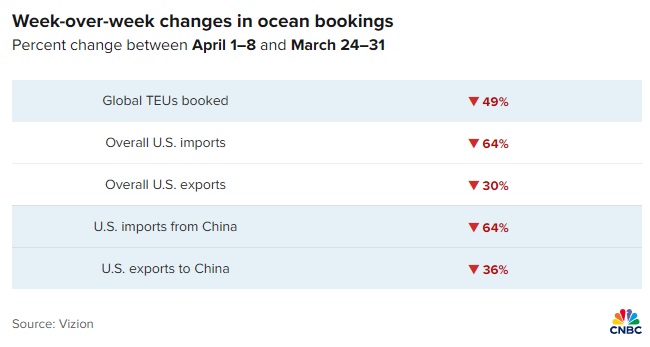
Container throughput from China’s main ports fell by 6.1% over the past week and cargo bookings over the next three weeks are projected to be down by 30-60% in China and by 10-20% in the rest of Asia as the trade war intensifies.
Market intelligence group Linerlytica said that recent tariff concessions are likely insufficient to restore transpacific volumes with about 30-40% of transpacific container imports still effectively halted by the tariffs that remain in place.
The trade war is principally affecting carriers with the largest exposure to Chinese transpacific exports to the US, with Hede (100%), Matson (90%), SeaLead (82%), TS Lines (80%) and COSCO (71%) being most at risk from the immediate fallout.
US container imports surged over the first three months of the year as retailers pulled forward volumes to get ahead of the tariffs.
But the Global Port Tracker from the NRF and Hackett Associates is predicting import cargo at the nation’s major container ports to drop dramatically beginning next month.
“Imports during the second half of 2025 are now expected to be down at least 20% year over year,” Hackett Associates Founder Ben Hackett said. “Even balanced against elevated levels earlier this year, that could bring total 2025 cargo volume to a net decline of 15% or more unless the situation changes.”
DEVELOPMENT
China's General Administration of Customs has changed its rules of how the origin of imported chips must be classified, now deeming that the wafer fabrication location should be counted as the origin of chips shipped to the country.
This rule exempts products from AMD, Nvidia, Qualcomm, Intel, and other chipmakers who outsource wafer fabrication to Taiwanese companies from the punitive 125% tariff China now imposes on products from the U.S. However, this badly hurts Intel, Global Foundries, Texas Instruments, and chip designers who produce chips in America
This helps China to bypass their own tariff regime in order to soften the blow to their own economy, similar to USA's action to soften the blow to theirs by removing semicon products to a separate bucket from the reciprocal tariffs.
DEVELOPMENT (10 May 2025)
U.S. President Donald Trump hailed talks with China in Switzerland on Saturday, saying the two sides had negotiated "a total reset ... in a friendly, but constructive, manner."
"A very good meeting today with China, in Switzerland. Many things discussed, much agreed to," Trump posted on his Truth Social platform.Trump added: "We want to see, for the good of both China and the U.S., an opening up of China to American business. GREAT PROGRESS MADE!!!" He did not elaborate on the progress.
KEYSTONE DEVELOPMENT (24 April 2025)
Eight specific tariff codes related to semiconductors and integrated circuits were exempted, reducing tariffs from 125% to 0%. This covered most semiconductors except memory chips
Select U.S.-made pharmaceuticals exempted from 125% tariffs, reducing the rate to 0%
SEMICON: The exact eight HS codes were not publicly disclosed in available sources due to China’s secrecy and the censorship of Caijing’s report on April 25, 2025.
Shenzhen-based import agencies, including Zhengnenliang Supply Chain, confirmed the exemptions during routine customs clearance on April 24, 2025, noting zero tariffs on eight integrated circuit codes.
China’s Ministry of Commerce and Foreign Ministry did not confirm the exemptions, and Caijing’s report was removed within three hours on April 25, 2025, indicating Beijing’s intent to keep the action quiet.
PHARMA: Michael Hart, president of the Beijing-based American Chamber of Commerce, reported on April 25, 2025, that some pharmaceutical companies imported drugs without tariffs over the past week, based on anecdotal member feedback.
A European medical equipment maker in China noted negotiations with Chinese authorities for tariff exemptions, suggesting critical drugs or APIs were prioritized to avoid supply disruptions.
No official confirmation from China’s Ministry of Commerce or customs authorities, with a Foreign Ministry spokesperson claiming ignorance on April 25, 2025.
DEVELOPMENT (8 May 2025)
Vietnam's surplus with the United States - already one of the highest globally - expanded by nearly 25% in the four months to April year on year, according to Vietnam's statistics agency. In March alone, it exceeded $13.5 billion, the highest monthly figure ever, U.S. data showed.
In April, shipments to the U.S. exceeded $12 billion, 34% higher than a year earlier, and the largest value recorded after the COVID-19 pandemic, Vietnam's customs data showed.Vietnam's Cai Mep deep-sea port, which handles most of the country's sea-borne exports to the United States, is experiencing a surge in shipments to the U.S., said Soren Pedersen, vice president at SSA Marine, which operates a port in Cai Mep and is one of the world's largest port operators.
At the same time, Vietnam is ramping up imports from China, which also reached a post-pandemic record in April, exceeding $15 billion, according to customs data.
Vietnam's exports to the U.S. in recent years have been fuelled by imports from China, with inflows from Beijing closely matching the value and swings of exports to Washington.
Point of view
"I’m looking at something to help some of the car companies where they’re switching to parts that were made in Canada, Mexico and other places and they need a little bit more time.
They’re going to make them here, but they need a little bit more time."
United States of America
... remarked during a bilateral meeting with El Salvador’s President Nayib Bukele in the Oval Office.
Point of view
"China and Europe should fulfil their international responsibilities… and jointly resist unilateral bullying practices"
People's Republic of China
... said during his meeting with Spanish Prime Minister Pedro Sanchez, Xi said China and the EU should cooperate more closely to deal with the growing trade tensions between Beijing and Washington.
This, he stressed, would not only “safeguard their own legitimate rights and interests, but also… safeguard international fairness and justice.”
Point of view
"Look, I'm a very flexible person. I don't change my mind, but I'm flexible," Trump said. "And you have to be. You just can't have a wall. Sometimes you have to go around it, under it or above it."
United States of America
... remarked during a bilateral meeting with El Salvador’s President Nayib Bukele in the Oval Office, commenting on being flexible on the tariffs issues.
Point of view
"It's about pursuing Australia's national interests, not about making common calls with China"
Australia
... rebuffing China's offer for a joint resistance as "the only way" to stop the "hegemonic and bullying behaviour of the US", appealing for Canberra's cooperation in an opinion piece on 10 April 2025.
Prime Minister Anthony Albanese, however, said Australians would "speak for ourselves", while the country's defence minister said the nation would not be "holding China's hand".
DEVELOPMENT
The AI chipmaking giant said it has worked with manufacturing partners to commission over 1 million square feet of manufacturing space to build and test Nvidia's advanced Blackwell chips in Arizona as well as AI supercomputers in Texas.
The company said it has already started production of Blackwell chips at TSMC's chip plant in Phoenix.
Nvidia is also building two supercomputer manufacturing plants in Texas – one with Foxconn in Houston and another with Wistron in Dallas. The company said it expects mass production to ramp up at both plants in the next 12 to 15 months. (source)
Point of view (4 May 2025)
"Amid rising uncertainties and long-term structural shifts, we reaffirm our full commitment to multilateralism, and a rules-based, non-discriminatory, free, fair, open, inclusive, equitable, and transparent multilateral trading system, with the World Trade Organization at its core."
ASEAN+3
... noted in the Joint Statement of the 28th ASEAN+3 Finance Ministers’ and Central Bank Governors’ Meeting at Milan, Italy.
The statement also noted the continued implementation of the Regional Comprehensive
Economic Partnership (RCEP) Agreement.
DEVELOPMENT (21-22 April 2025)
Malaysia Airlines is seizing on the opportunity to expand its fleet by targeting Boeing jets that Chinese airlines may reject. | Air India Ltd. is looking to take Boeing Co. planes rejected by Chinese carriers, people familiar with the matter said, joining the ranks of Asian airlines vying to benefit from the trade war between Washington and Beijing.
According to major news sources, Datuk Captain Izham Ismail, MAG’s managing director, confirmed that Malaysia Airlines is in talks with Boeing to secure delivery slots vacated by Chinese carriers.
This could fast-track the airline’s goal of operating 55 next-generation Boeing 737 MAX jets by 2030. These potential acquisitions would notably be separate from MAG’s existing order of 25 737 MAX aircraft.
Air India, the Tata Group-owned carrier, which urgently needs aircraft to expedite its revival, plans to approach Boeing about acquiring a number of jets the US planemaker was readying for Chinese airlines before reciprocal tariffs thwarted the handovers, according to the people, who are familiar with discussions at the Indian airline and didn’t want to be identified because the information isn’t public.
Air India is also eager to take up slots for future deliveries should they become available, the people said.
DEVELOPMENT
The United States and Vietnam agreed to start talks for a trade agreement, the Vietnamese government said on Thursday, hours after the U.S. paused the implementation of global "reciprocal" tariffs, including a 46% levy on Vietnam.
- The two countries will consider removing as many non-tariff barriers as possible, Hanoi said in a statement released after a meeting between Vietnam's Deputy Prime Minister Ho Duc Phoc and U.S. Trade Representative Jamieson Greer in Washington.
- Export-reliant Vietnam is hoping to get the duties reduced to a range of 22% to 28%, if not lower (rumor)
- Vietnam to tighten controls and officials were given two weeks to devise a plan to clamp down on illicit transhipment. The deadline could be extended until late April, while Hanoi wanted to be careful not to provoke China. (rumor)
Illicit transhipment refers to one country sending goods to a nation facing lower tariffs from a third country, to which the product is re-exported without having value added to it.
- Vietnam's government said on its official portal it would crack down on "trade fraud." It did not provide specifics.
- Two Vietnamese airlines announced deals with U.S. financial companies to fund their expansion. (10 April 2025).
VietJet sign 300 million deal with AV AirFinance to facilitate the delivery of planes it needs over the next two years. Purchases of planes would be crucial to reduce Vietnam's large surplus with the United States.
Vietnam Airlines announced a separate non-binding deal with Citibank (C.N), worth more than $560 million aimed at "strengthening the airline's operational capacity and expanding its international route network in the years ahead,"
DEVELOPMENT
Over 40 cooperation agreements were signed on April 14, focusing on trade, supply chains, and infrastructure, though specific financial commitments were not disclosed. (read more)
Supply Chains: Deals to enhance production and supply chain resilience, particularly for electronics and manufacturing, to counter U.S. tariff disruptions.
Railway Cooperation: Agreements to assess new railway projects, with China potentially funding and providing technology for Vietnam’s rail network upgrades.
Trade Certification: A memorandum between the China Council for the Promotion of International Trade and the Vietnam Chamber of Commerce to boost cooperation on certifying goods’ origins, addressing U.S. concerns about Chinese transshipments.
Emerging Sectors: Pacts to expand collaboration in 5G, artificial intelligence, and green energy, aiming to integrate Vietnam into China’s tech ecosystem.
Cultural Ties: Plans for a “Year of Vietnam-China Humanistic Exchange” in 2025 to strengthen people-to-people connections.
Point of view
"I don't blame China, I don't blame Vietnam. I see they're meeting today. Isn't that wonderful? That's a lovely meeting...
...trying to figure out, how do we screw the United States of America?"
United States of America
... remarked during a bilateral meeting with El Salvador’s President Nayib Bukele in the Oval Office, commenting on Xi Jinping's visit to Vietnam.
DEVELOPMENT
Newsom and the state's attorney general, Rob Bonta, filed the lawsuit in San Francisco federal court, which represents the first challenge from a US state against the president's tariff plan.
"This is recklessness at another level. The geopolitical impacts are outsized. The trade impacts are outsized," Newsom said alongside Bonta. "No rationale, no plan, no conscience to what it's doing to real people."
"He is yet again violating the US Constitution, overriding Congress's authority, and breaching the separation of powers," the attorney general said.
"It's simple. Trump does not have the authority to impose these tariffs," he added.
"Donald Trump's tariffs do not represent all Americans, particularly those I represent here in the fifth-largest economy in the world, the state of California," Newsom said at the time. "California is a stable trading partner, and we hope you remember that as you consider California-made products."
White House spokesman Kush Desai in a statement criticized the lawsuit.
"Instead of focusing on California's rampant crime, homelessness, and unaffordability, Gavin Newsom is spending his time trying to block President Trump's historic efforts to finally address the national emergency of our country's persistent goods trade deficits," he said.
Point of view
"If you look at the US, while our overall tariff may be 17%, a lot of its products that we don't import at all. Our applied tariff to the US is probably 7 or 8%. Its not humongous."
Union Minister of Commerce and Industry
India
... was speaking at the India Global Forum in Mumbai. The minister further said that India's tariffs were a protection against unfair trade and a shield against economies engaging in practises like dumping.
Goyal blamed China for the current global crisis adding that China's entry into the World Trade Organisation (WTO) in the 1990s and early 2000s was a turning point.
DEVELOPMENT
31 Cooperation Agreements: Signed memoranda of understanding (MOUs) (read more)
Trade and Services: Expanded trade, including fresh coconut exports from Malaysia and increased Chinese tourism.
Agriculture: Access for Malaysian agricultural products (e.g., durians, coconuts) to Chinese markets.
Digital Economy and AI: Collaboration in artificial intelligence, digital innovation, and joint labs.
Infrastructure: Railway connectivity and industrial park development, advancing Belt and Road Initiative projects.
Visa Exemptions: Mutual visa-free travel to boost people-to-people exchanges.
Global Security: Cooperation on international and regional issues.
Free Trade Advocacy: Xi and Anwar opposed protectionism and unilateralism, advocating for open global supply chains and a multilateral trading system, implicitly criticizing U.S. tariffs.
South China Sea: Both reaffirmed commitment to peace and stability, with Malaysia supporting China’s regional role.
ASEAN-China Relations: Xi endorsed Malaysia’s 2025 ASEAN chairmanship, pledging to advance the ASEAN-China Comprehensive Strategic Partnership and discuss a China-ASEAN free trade agreement.
Cultural Dialogue: Xi proposed a “Confucian-Islamic Civilizational Dialogue” to deepen cultural ties.
DEVELOPMENT
Chinese President Xi Jinping met Cambodian Prime Minister Hun Manet and Senate President Hun Sen, emphasizing an "all-weather China-Cambodia community with a shared future."
37 documents were signed on investment, trade, finance, and infrastructure, though details on binding commitments were not disclosed.
Funan Techo Canal: Xi reaffirmed China’s support for the $1.7 billion Funan Techo Canal, a BRI project (49% Chinese-funded, 51% Cambodian), aimed at reducing Cambodia’s reliance on Vietnamese ports by connecting the Mekong River to the Gulf of Thailand.
Tourism: Both leaders designated 2025 as the China-Cambodia Year of Tourism to boost cultural and people-to-people exchanges.
Xi urged Cambodia to "resist protectionism" and oppose "hegemonism," advocating for deeper cooperation under the Belt and Road Initiative (BRI).
LATEST ON FINANCE & ECONOMICS
[ Donbass Front ] Entire Ukraine’s line north of Severodonetsk in Luhansk is broken
Large portion of territory north of Severodonetsk has fallen to the Luhansk People’s Republic – Russian forces. If all the other unmarked territory is under Russian control – Luhansk is effectively 90% “liberated”. — edit — My theory that 90% of Luhansk is liberated had just got corroborated by a Russian article: Liberation of the…
[ Crimea Front ] Heli insertion north of Mykolaiv – Battle for Mykolaiv International Airport
4 Helicopters were reportedly inserting Russian troops into the town of Balovne, north of Mykolaiv and the forces immediately proceed to try to capture Mykolaiv International Airport which were met by Ukrainian defenders. To the north-east of Mykolaiv, a major convoy of up to 800 vehicles were allegedly destroyed by the Ukrainian forces and air…
[ Crimea Front ] Battle for Vozesens’k by Russian airborne troop
Russian forces has been confirmed to be attacking Voznesensk, which is the location with a nuclear power plant to it’s north. As there are no indication of a “land route” towards this city, we assessed that this could be airborne operation insertion via helicopters.
[ Donbass Front ] Major advances reported in North-eastern Ukraine, with Russian forces present in Balakliya, Svatove, Chuhuiv and Bohodukhiv….
Major advances reported in North-eastern #Ukraine, with Russian forces present in Balakliya, Svatove, Chuhuiv and Bohodukhiv…. Its wasnt clear the Svatove forces was from Kupyansk or Starobilsk until I saw this in one of the telegram channels This is the latest order of battle being shared from the #Russia-centric telegram #Ukraine is still holding most…
Fighter jets donation deal off! Poland, Bulgaria and Slovakia rejected request to give Ukraine their Russian-made planes
In a stunning reversal of what would be the most dramatic military aid to Ukraine from European Union, Ukrainian pilots that had arrived in Poland to take control of the donated fighter planes will leave empty handed as the 3 European countries that still fly Russian made planes similar to Ukraine had all rejected to…
[ Donbass Front ] Russian forces captures Starobils’k
Photo, video as well as Russian sources confirms that the Russian forces have taken the city of Starobils’k in the Luhansk region.
[ Kyiv Front ] Belarussian column spotted in Chernihiv – Ukraine Northern Territorial Army
According to official Ukrainian government sources, Belarus has reportedly entered the war. The Belarussian column was spotted in Mykhailo-Kotyubyns’ke – travelling towards Slabyn or Pakul The column is reportedly 33 vehicles long, of which 11 of them are “Grad” MLRS vehicles. https://www.unian.ua/war/biloruski-viyska-zayshli-na-chernigivshchinu-novini-donbasu-11723482.html
[ Crimea / Donbass Front ] The Battle of Mariupol’ has begun
There are video evidence + geolocation by OSINT that the Battle of #Mariupol has officially begun.
[ Reuters ] Belarus referendum approves proposal to renounce non-nuclear status
A referendum in Belarus on Sunday approved a new constitution ditching the country’s non-nuclear status at a time when the former Soviet republic has become a launch pad for Russian troops invading Ukraine, Russian news agencies said. The agencies cited the Belarus central elections commission as saying 65.2% of those who took part voted in…
[ Crimea Front ] Russians forces has captured Berdyans’k
According to the latest information circulating around, the Russian forces had captured Berdyansk with the Mayor of the city reportedly announcing that all official buildings in the city is now in Russian control.
Summary of Military Aid to Ukraine in Feb 2022 as of 27 Feb
Germany1000 anti-tank weapon500 Stinger missiles Netherland400 rocket-propelled grenade (RPG) launchers200 Stinger missiles100 sniper rifles30000 rounds of ammunition? x radar devices? x landmine detectors Poland ? x ammunition Estonia? x 122mm howitzers? x Javelin anti-tank missiles Latvia ? x Javelin anti-tank missiles Lithuania? x Stinger missiles? x ammunition Bulgariaannounced but unknown Belgium2000 machine guns3800 tonnes fuel…
Germany finally stop their military rot: promising to keep defense spending above NATO’s 2% GDP requirement
Germany, one of the country specifically called out by former US President Donald Trump, for failing to meet NATO requirement of annual defense spending of at least 2% of the GDP, has finally committed officially to keep it’s defense spending over 2% of GDP immediately. This is the most significant shift in Germany’s policy when…
[ Luhansk / Donbass Front ] Major advanced by Russian forces in Luhansk: Schastia, Muratove, Smolianynove, Novookhtyrka taken
In a stunning advance, Russian forces break through the Schastia defenses as well as the line north of the city and made a 40-50km push to the outskirt of twin cities of Severodonetsk and Lysychans’k, as the Ukrainian forces in the region fall back into the 2 cities. Ukrainian forces are now bracing for an…
[ Kharkiv Front ] Undefended Kupyansk’s Mayor negotiated free passage for Russian troops; escorted by police
Kup’yans’k mayor, negotiated with Russian forces that had arrived at his city to allow them free passage and had informed them that there are no Ukrainian military in the city. Russian forces had passed through the city with police escort. Direction on where the Russian forces went after is currently unclear. But an educated guess…
[ Crimea Front ] Mykolaiv repelled Russian night attack
Mykolaiv reported heavy fighting in the night. However, it appears that Ukraine continues to hold full control over the city. Mykolaiv is an important hub that is the gateway to the South-west region of Ukraine. If the city falls to the Russians, the port city of Odessa will be threatened.
Belarus to vote on constitutional changes to host nuclear weapons and effectively make Lukashenka a dictator – Russia pushed to the brink
Lukashenka, 67, has proposed amending the constitution, the third time he has done so since coming to power in 1994, that would allow him to rule to 2035, offer him a new lever of power, and abolish a section of the document defining Belarus as a “nuclear free zone,” possibly paving the way for the…
[ Donbass Front ] Russia cuts communications between Volnovakha and Mariupol after taking Donskoye; capture Markivka and Kryz’ke in Luhansk
Russian forces made some progress north of Bilovods’k in Luhansk, as well as just south of Volnovakha. The capturing of Donskoye and Novomykolaivka means that the road between Volnovakha and Mariupol is now closed to the Ukrainians. This adds further concerns to the closing of the encircling of Mariupol from both sides. The only “escape…
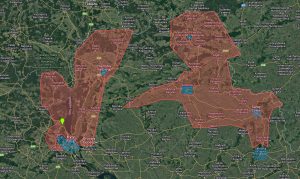
[ Kyiv / Sumy Front ] Stalemate as Russian unable to make progress
After trying to find out what is the situation in the various cities that are under siege, we could not find significant information of any progress by the Russians on the ground. The only change from yesterday, is that the Russian are trying to reinforce the east flank of Kyiv through the Kruty-Nizhyn line (the…

Ukraine Defense Minister, Oleksii Reznikov call for citizens to lookout for spies and attack supply convoys
Dear Ukrainians! Over 55 hours of resistance. Our defenders have destroyed the enemy’s plans. As of this morning, the number of Russian occupiers killed has exceeded 3,000. More than 200 interventionists are captured. The number of captives is increasing. They did not expect such a response and themselves. Hundreds of armoured vehicles have been destroyed,…
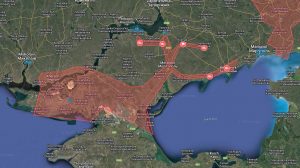
[ Crimea Front ] Russian Blitz from Melitopol: Enerhodar, Vasylivka braces for battle, Berdans’k encircled, 2 separate forces heading towards Mariupol from the west & north-west
Russian forces from the Crimea front had split into 4 different forces from their newly captured city of Melitopol. Intel shows that Dnieper river cities of Enerhodar and Vasylivka are bracing for attacks by huge columns of Russian forces. The Russian detachment that went towards Tokmak, had paste Chernihivka, and continued eastward. The southern most…
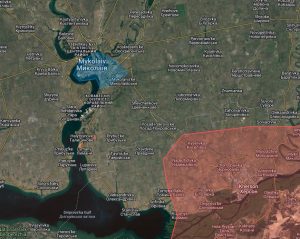
Mykolaiv still fully under Ukrainian control; braces possible attack
Due to the lack of “actions” and information by the Russians in Mykolaiv and beyond; and additional information that had came up within Mykolaiv on the capture of Russian saboteurs/soldiers and information of the preparation against a possible attack by Russian tanks confirm that Ukraine forces still have full control over the city.
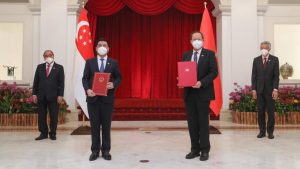
[ CNA ] Singapore and Vietnam sign 5 agreements, MOUs across defence, trade and social sectors
Singapore and Vietnam signed five agreements and memoranda of understanding (MOUs) on Friday (Feb 25), aimed at strengthening cooperation in defence, the digital economy and intellectual property among other areas. The signing by ministers and senior officials from both countries was witnessed by Singapore Prime Minister Lee Hsien Loong and Vietnam President Nguyen Xuan Phuc.…
Ukraine forces breakthrough Russian lines and takes Bilovods’k in Lugansk
Ukraine Defense Ministry announced their forces attacked Russian forces at noon in the Bilovods’k region, broke through Russian positions and consolidated the success. Russian units are allegedly routed towards the Russian border after heavy losses.
Russia recaptured Antonov Airport (Gostomel) and condor off the west side of Kyiv
Reports of Russian Defense Ministry announcing the capture of Antonov Airport and claimed that they had blocked Kyiv from the west. 200 Ukrainian special forces troops are claimed to be killed in operation.
[ Kyiv Front ] Chernihiv remains in Ukraine control
We have seen enough postings to confirm that Chernihiv did not fall to the Russia forces as we had believed yesterday. The map is now updated to show the defense of Chernihiv. Social media postings reported that the Russian forces are engaging the defenses of Chernihiv, while large number of the Russian forces bypassed Chernihiv…
[ Civil.ge ] Georgia Won’t Join Russia Sanctions, PM Says
Georgian Prime Minister Irakli Garibashvili announced today Tbilisi will not join international sanctions on Russia over its full-scale attack on Ukraine. “I want to state clearly and unambiguously, considering our national interests and interests of the people, Georgia does not plan to participate in the financial and economic sanctions, as this would only damage our…
Russian forces are sighted in Melitopol
We can safely assume that Melitopol had fallen to #Russia. This development may mean that Russia might be considering cutting supply lines to the #Ukraine frontline units that are holding out very well on the Donbass front, OR… attempting to go east and encircle the forces in Mauripol – it’s still not clear yet, as…
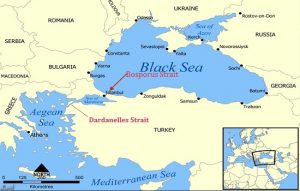
[ National Post ] Turkey cannot stop Russian warships accessing Black Sea, says foreign minister
Turkey cannot stop Russian warships accessing the Black Sea via its straits, as Ukraine has requested, due to a clause in an international pact that allows vessels to return to their home base, the Turkish foreign minister said on Friday. Ukraine has appealed to Turkey to block Russian warships from passing through the Dardanelles and…
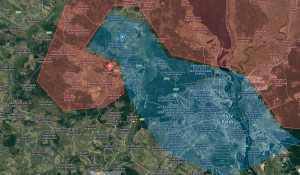
[ Kyiv Front ] Ukraine retakes Antonov Airport, Russia takes Vorzel
Antonov Airport is reportedly recaptured by the Ukrainian forces. However, the Russian had taken Vorzel, south of the airport, in a possible encirclement of the airport.
Ukrainian president announces general mobilization of all conscripts and reservists within 90 days
Ukraine President Volodymyr Zelensky had ordered a general military mobilization through out Ukraine. The mobilization will be carried out within 90 days, and expect to provide the government with personnel, vehicles, infrastructure and land use for the defense operations. All male citizens between 18-60 will be banned from leaving the country. Local government officials would…
Ukraine-Russia War Day 1 SITREP – Russia attacking on 5 fronts
If you missed the “actions” from Day 1 of the #Ukraine-#Russia war; or you are confused what actually happened and what is the situation on the ground now… Watch this quick SITREP that sums up the situation on the ground in Ukraine: (pls subscribe!)
[ Crimea Front ] Mykolaiv is likely to have fallen to the Russian
We have good reasons to believe that Mykolaiv had fallen to the Russia in the past few hours as there are social media footage that show Russian forces inside of Mykolaiv. All LIVE camera feed of Mykolaiv had also went down. We can safely assume that Russian had taken Mykolaiv as a result.
[ Suny Front ] Konotop encircled; Okhtyrka repelled Russian offensive twice
Based on the update by Suny Regional State Admin Chairman, Russia had encircled Konotop and Okhtyrka repelled Russian offensive twice. He also reported Russian forces are from this front is heading towards Kiev. OSINT UKRAINE@OSINT_Ukraine????⚡️Chairman of the Regional State Administration of Sumy Dmitry Zhivitsky has released a video stating that Russia has encircled Konotop (see…
Belarus denied claims that Belarus took part in the attack on Ukraine
President Alexander Lukashenko of Belarus has denied claims that his nation is taking part in a Russian attack on Ukraine, Belarusian state media reported on Thursday. Ukrainian border guards had made the accusation against Minsk earlier in the day. The Ukrainian statement asserted that some of the Russian troops entering Ukraine came from the territory of neighboring Belarus,…
Zelenskyy calls on all citizens with military experience to “join the defence of Ukraine”
Sky News@SkyNews·15m Ukrainian President Volodymyr Zelenskyy calls on all citizens with military experience to “join the defence of Ukraine”, and asks for people to donate blood as there are “wounded soldiers in hospitals”. I thought he said his military was stronger than it was 8 years ago? Now he is asking civilians to suicide. And…
[ Aerotime ] Ukrainian Su-27 fighter intercepted in Romania
Two F-16 Fighting Falcon fighters of the Romanian Air Force were scrambled to intercept an unauthorized flight approaching the national airspace on February 24, 2022. The jets carried out a visual identification of the aircraft, which appeared to be a Sukhoi 27 belonging to the Ukrainian Air Force. The fighter was escorted to the RoAF…
General Staff of Ukraine Armed Forces: Russia did not land in Odessa
General Staff of the Ukrainian Armed Forces said that the information about the landing of the Russian troops in Odessa is false. The information is part of the press statement on UNIAN as they report on the Russia’s attack on Ukraine. “Today, February 24, at 5:00, the armed forces of the Russian Federation began intensive…
Biden reimposed sanctions on Russia’s Nord Stream 2 pipeline after lifting it 9 months prior
“Yesterday, after further close consultations between our two governments, Germany announced that it would halt certification of the pipeline. Today, I have directed my administration to impose sanctions on Nord Stream 2 AG and its corporate officers,” “These steps are another piece of our initial tranche of sanctions in response to Russia’s actions in Ukraine. As…
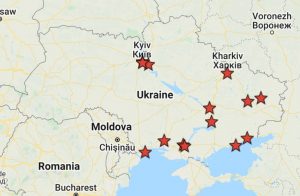
Putin announces “Special Operation” – multiple Ukrainian cities reported explosions
Explosions were reported across multiple cities in Ukraine, including Kyiv, Kharkiv, Odessa and Mariupol. There are also unverified reports that amphibious assault on Mariupol and Odessa. Mariupol is in Donetsk oblast. But if Russian troops lands in Odessa (which is west of Crimea), it would invalidate our assessment that this would just be a limited…
Donbas is the final warning from Putin
As the world buzzes with the news of Putin recognizing the independence of the Donetsk People’s Republic and Luhansk People’s Republic + the decreed to OFFICIALLY deploy the Russian military into the 2 regions as “peacekeepers” – the headline calling this an invasion is actually a bit of a misnomer. You can’t invade what you…
Russia will not invade Ukraine… unless…
There are so much media hype and perhaps, even misinformation, on the “Ukraine Crisis” – as the western media narrative of an impending invasion of Ukraine by the Russia – the layman on the streets are not going to realise how far it is from the reality. Yes, Russia had massed a lot of forces…

[ CNA ] RSAF to fly F-16 fighter jets for ‘at least’ another decade, following F-35 developments ‘closely’: Air force chief
“We will continue to operate these (F-16) fighter aircraft for at least another decade and are working towards replacing the F-16s at the end of their operational life,” MG Khong said in written responses to questions posed in conjunction with this year’s Singapore Airshow. MG Khong said the RSAF’s fleet of F-16C/Ds is being upgraded in phases,…

[ GovCon Wire ] State Department OKs $14B Boeing F-15 Aircraft Sale to Indonesia
The State Department has approved a potential sale to Indonesia of F-15 fighter aircraft built by Boeing (NYSE: BA) and associated equipment through an estimated $13.9 billion government-to-government agreement with the U.S. Indonesia’s foreign military sales request includes 36 F-15ID jets, 87 F110-GE-129 or F100-PW-229 engines, 92 embedded GPS security devices and 40 M61A Vulcan gun systems, the…

Indonesia signs 8.1 billion USD deal to buy 42 Rafale fighter jets from France
Indonesia had just confirmed and signed the 8.1 billion US dollar contract to buy 42, Rafale fighter jets from France’s Dassault Aviation SA. This is another big coup for Dassault after United Arab Emirates confirmed their purchase of 80 Rafales last December, following other earlier deals with Greece, Croatia and Egypt. The order comes with…

Video of F-35 crashing over South China Sea going viral – Watch it here
A video of the final approach of the F-35 that crashed and fallen into the South China Sea had went viral across the internet and had been reproduced and shared on social media platforms. DPA had acquired the footage and reproduced the clip in slow motion. From the short clip, it seems like the fighter…
[ MEMO ] Israel rejects selling Iron Dome defence system to UAE
Israeli security agencies have rejected selling the Iron Dome and David’s Sling Weapons System to the United Arab Emirates (UAE), Israel Hayom and Maariv reported military analysts revealing on Friday. According to Maariv, military analyst Alon Ben David said that the Israeli security agencies rejected the potentiality to sell developed technologies to its new partners, referring to…

[ Sputnik ] Russia Offers India to Develop New Tank Based on Armata, Military Agency Says
Moscow has offered New Delhi to develop a new Indian combat tank on the basis of the Russian Armata platform, the spokeswoman for Russia’s Federal Service for Military-Technical Cooperation, Valeria Reshetnikova, told Sputnik. “Taking into account Indian military plans on starting the development of a new combat tank, in the framework of a recently held Russian-Indian…

Philippines signs 369.3 million USD deal with India to buy the BrahMos shore-based anti-ship cruise missiles
The Philippines’ Department of National Defense announced on the Philippines government news agency, that they had officially signed the contract for the acquisition of India’s BrahMos medum-range ramjet supersonic cruise missiles. Defense Secretary Delfin Lorenzana and BrahMos Aerospace director general Atul Dinkar Rane signed the contract worth PHP18.9 billion (estimated 369.3 million USD) in a…

[ Express ] Global tensions grow as Chinese rocket scientist defects to the West
Described as a rocket technician, the Chinese national was attached to the stateowned Aviation Industry Corp of China, where he helped develop a mid-range hypersonic boost-glide vehicle capable of carrying DF-17 missiles to a range of up to 2,000 miles. Sources say the scientist, in his 30s, is connected with a more recent hypersonic missile…
NATO doubled down as the alliance demands Russian withdrawal from Ukraine, Georgia and Moldova
NATO had officially replied to Russia and provided NATO’s own proposals to Russia. In short, NATO basically doubled down on their position and further demanded Russian withdrawal from Ukraine, Georgia and Moldova. Russia was waiting for a reply from the United States, and the reply had instead came from NATO, and in General Jens Stoltenberg…