The Great Pivot: Why the UAE Just Quit OPEC and Went All-In on the USA

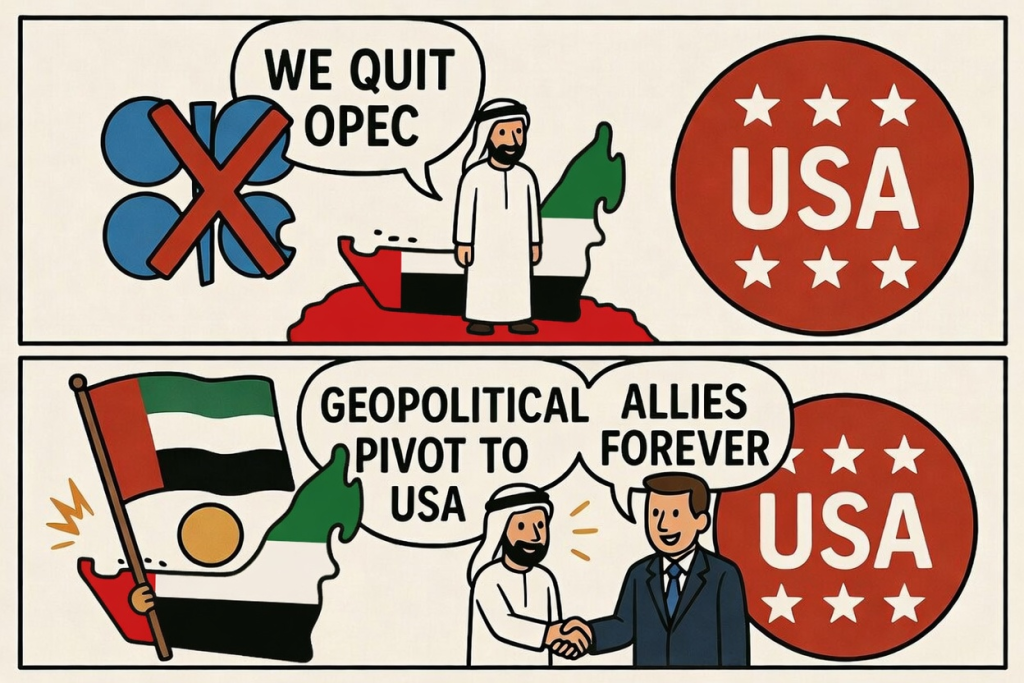
In a move that has sent shockwaves through global energy markets and geopolitical circles, the United Arab Emirates (UAE) has officially announced its withdrawal from OPEC and the OPEC+ alliance, effective May 1, 2026.
This isn’t just a change in oil policy—it’s a massive geopolitical realignment. The UAE is no longer content playing “second fiddle” in a Saudi-led energy bloc; it is carving out a bold, independent path that fundamentally shifts the balance of power in the Middle East.
Breaking the Cartel: Economic Sovereignty
For years, simmering tensions over production quotas defined the UAE’s relationship with OPEC. While Saudi Arabia pushed for cuts to keep prices artificially high, Abu Dhabi spent billions expanding its own capacity. By exiting the cartel, the UAE has claimed its economic sovereignty. Under the guidance of Energy Minister Suhail bin Mohammed al-Mazrouei, this “policy-driven evolution” allows the UAE to:
- Maximize Production: Fully utilize its massive infrastructure to pump more oil and maximize immediate revenue.
- Dictate Pricing: Operate on a market-driven strategy, free from the collective mandates of the cartel.
- Fund the Future: Use the surge in revenue to fast-track “Vision 2031.”
From “Black Gold” to “Digital Gold”
The most daring part of this pivot is the shift in focus. The UAE is aggressively transitioning its economic engine from oil to Artificial Intelligence. The goal is simple: become the AI capital of the Middle East.
This isn’t just a vague ambition; it’s a structured bet. The UAE has committed to a decade-long investment plan in U.S.-based AI infrastructure. By 2028, Abu Dhabi aims to have 50% of its government operations powered by agentic AI, potentially making it the first nation on earth to operate at such a scale with autonomous systems.
The Security Trade-off: The US-Israel Connection
This exit is as much about survival as it is about money. The ongoing volatility in the region—specifically the Iran conflict and the blockade of the Strait of Hormuz—exposed the UAE’s vulnerability. Finding themselves under threat while regional “allies” remained passive, the UAE decided to secure a more robust shield.
This has led to two critical developments:
1. The US “Swap Line”: The UAE secured a direct swap line with the U.S. Treasury, allowing it to access US dollars without selling off American assets. This effectively elevates the UAE to the status of a top-tier U.S. strategic ally.
2. The Israel Shield: In a historic first, Israel reportedly deployed Iron Dome batteries to the UAE to help intercept Iranian missiles.

A Fractured Middle East
The UAE’s departure signals a fragmentation of the traditional Arab unified front. Feeling betrayed by neighbors like Pakistan during recent conflicts and finding themselves in direct competition with Saudi Arabia’s regional ambitions, the UAE has opted out of the “geopolitical games” of the past.
By withdrawing from foreign adventures in Yemen and Somalia, Abu Dhabi is choosing “agile” diplomacy—prioritizing national security and high-tech growth over old-school regional power struggles.
The Bottom Line: The UAE is signaling that it is ready to be a standalone global power. By leveraging energy wealth to buy into the future of American technology and security, they are betting that in a multipolar world, Western tech and high-level security are the ultimate currencies.
Full Video Report: