News & Analysis Military & Defense
US Navy Shipbuilding Crisis: Why Trump’s Grand Navy Needs Japan and South Korea
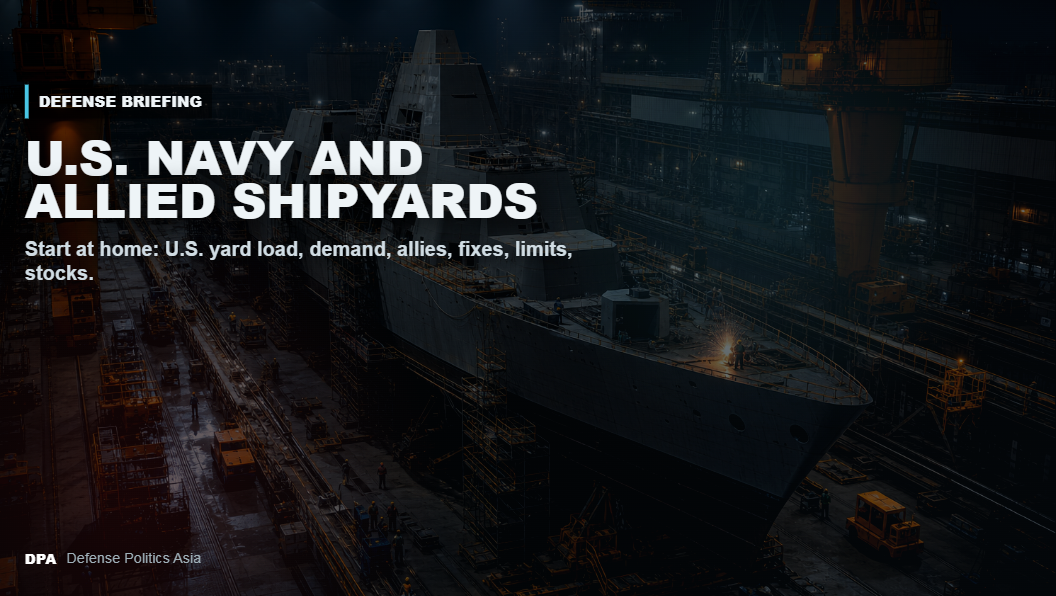
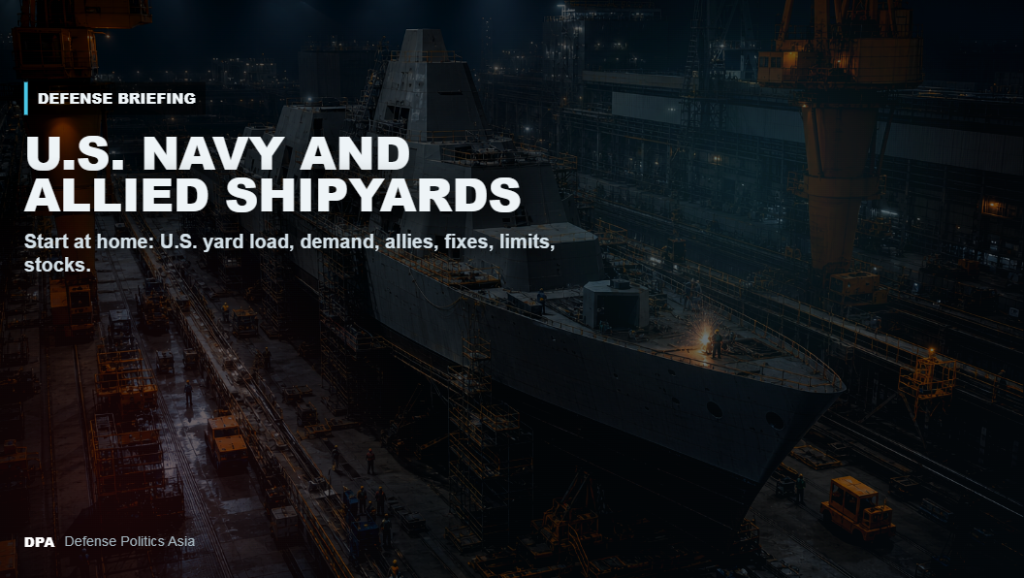
The United States has been making big announcements over the past year about expanding the US Navy. Donald Trump even wants his own “Trump-class” battleship. But there is a fundamental problem standing in the way: the United States has lost most of its shipbuilding capacity.
The number of shipyards in the US is dangerously low, and they simply do not have the ability to immediately build the grand navy the President wants. Recent developments suggest the US is now exploring how to work around this—rethinking what they should build domestically and what they should depend on allies for, particularly Japan and South Korea.
The Yard Crunch
The US Navy is locked in by law: most of its combat ships must be built domestically. But there are only a handful of US Navy shipyards and ship builders, and they are completely overloaded.
These yards have to build everything at once: the Columbia-class SSBN submarines, destroyers, amphibious ships, attack boats, the new frigate program, cruiser replacements, and logistics ships—oilers and service vessels. On top of all that, they still need to handle maintenance and repairs. Welding, combat system installation, and nuclear force work all take years.
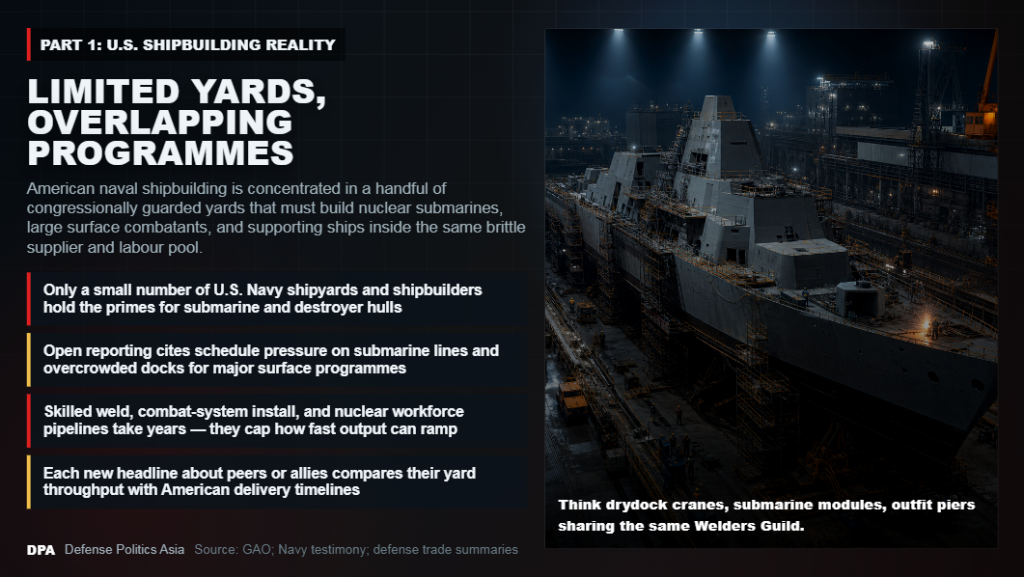
Pentagon and Congress keep ordering more ships, but they all have to queue. They cannot build them simultaneously. The yards compete not just for slots, but also for steel and subcontractors. It is an insane situation. Despite the desperation to catch up to China’s massive shipbuilding lead, the US simply cannot deliver based on current infrastructure.
The Allied Shipyard Tour: Not Outsourcing, But Studying
A lot of media has reported that the US is now looking to outsource shipbuilding to Japan and South Korea. That was my first impression too. But on closer study, that’s not exactly what is happening.
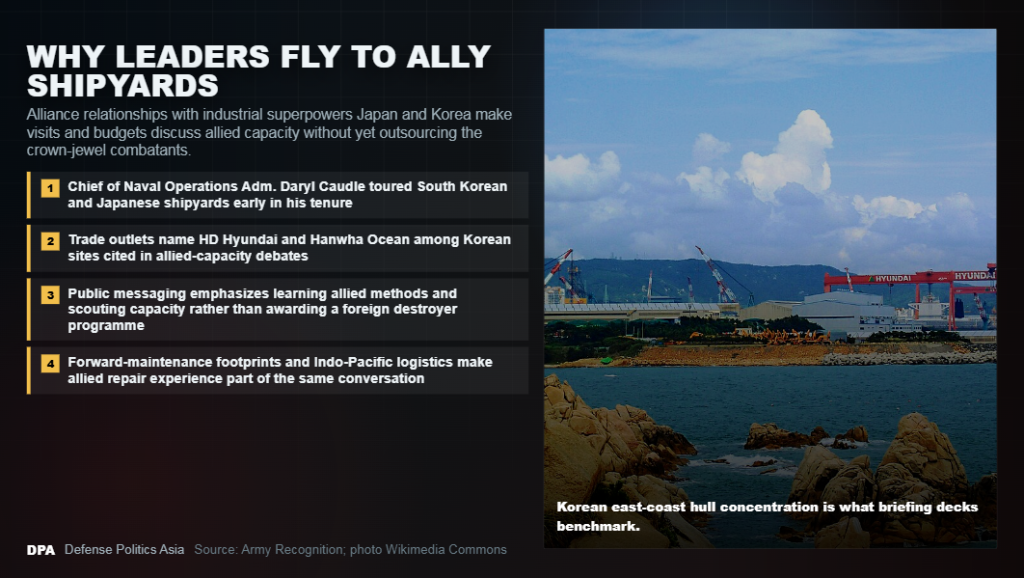
Chief of Naval Operations Admiral Daryl Caudle toured South Korean and Japanese shipyards primarily as a study trip. The emphasis was on learning the allied methods—how Japan and South Korea manage their pipelines—and scouting for capacity. The aim is not to award destroyer programs to foreign shipyards, because that is bound by US law.
What is interesting to me is the concept of forward maintenance and Indo-Pacific logistics. This is the workaround. If South Korean and Japanese shipyards can take over a good fraction of the maintenance and repair load for US Navy ships, it frees up massive amounts of slot time in American shipyards to actually build new ships. That is a clever solution.
Hybrid Supply: Modules from Overseas
In April 2026, Navy Secretary John Phelan said the Navy is studying whether to build hulls outside of the United States. The current options on the table include:
- Forward MRO (Maintenance, Repair and Operations): Letting allies handle the upkeep of forward-deployed US Navy assets. This builds relationships and codependence with allies, which is strategically very good.
- Modules in US Yards: Certain non-sensitive parts of ships—possibly even the entire hull—built overseas, then shipped to the US for final assembly. The sensitive components like sensors, weapon systems, and nuclear powerplants stay in American hands.
- Studying Allied Designs: Looking at the Mogami or Daegu-class ships. Though honestly, the US doesn’t really need foreign designs. The main problem is not designs—the main problem is production capacity.


The Auxiliary Logistics Problem and the Jones Act
There’s a separate issue with auxiliary and logistics vessels. Combat ships have strict laws keeping them domestic. But auxiliary logistics ships might be treated more like civilian vessels, opening them up to foreign builders.
Only about three US shipyards still build commercial ships, and they are two to three times more expensive than overseas yards. As a result, only a tiny percentage of commercial ships built in the past two decades are made in the United States. The rest are mostly from South Korea and China.
This connects back to the Jones Act, the post-WWI law requiring that merchant ships moving between US ports must be majority-built, majority-owned, and majority-crewed by Americans. The Jones Act is the main reason the US shipbuilding industry has contracted so massively. American costs are too high.

But the Jones Act exists for a critical strategic reason: a healthy commercial shipbuilding industry can rapidly convert to military production in wartime. That is exactly what happened in World War II. Right now, if the US fell into a World War II situation, it may not actually have the capability to surge ship production without massive brute-force intervention.
Trump has also already issued executive orders restricting Chinese-produced ships from porting in the US, with additional tariffs as well. This is a continuation of the strategy to staff up shipbuilding in friendly countries and hopefully bring some of it back home.
The First Move: HII and Hyundai Sign On
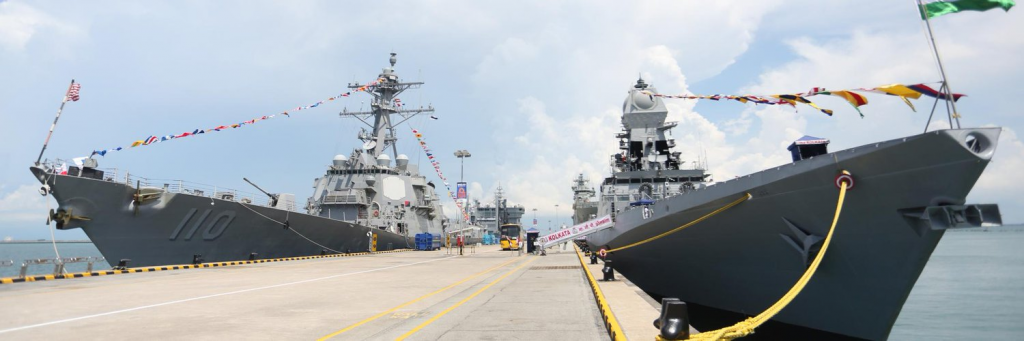
There is already a precedent. Huntington Ingalls Industries (HII) and HD Hyundai Heavy Industries have signed a Memorandum of Agreement covering logistics-ship teaming, module integration, and Indo-Pacific lifecycle support.
So companies have allies too. This means HII can now do maintenance work in South Korea. This is a prime example of what might become the new norm: where the US, unable to build everything alone, plugs its bottlenecks with allied capacity.
The Verdict
For now, this is mostly evaluation and budgeting—nothing has been signed for hull-building offshore. The realistic near-term plan looks like this:
- Domestic yards keep building the prime combatants.
- Non-sensitive auxiliary and logistics ships, modules, and forward MRO get pushed to allies.
- Multi-year procurement and accelerated milestone payments give subcontractors confidence to invest.
- Private capital expands dry dock modernization, crane capacity, and digital shipyard tooling.
- Apprentice schools and visas build up the workforce.
I do not expect sensitive shipbuilding or entire US Navy combatants to ever be built overseas. Security classifications will always block foreign yards from handling classified military tech and nuclear propulsion. Congress will never grant that access.
But the shift is real. The US Navy is finally accepting it cannot do this alone. Japan and South Korea—two countries with world-class shipbuilding capacity sitting right next to the most contested waters on Earth—are about to become indispensable to American naval power.
Full Video Report: